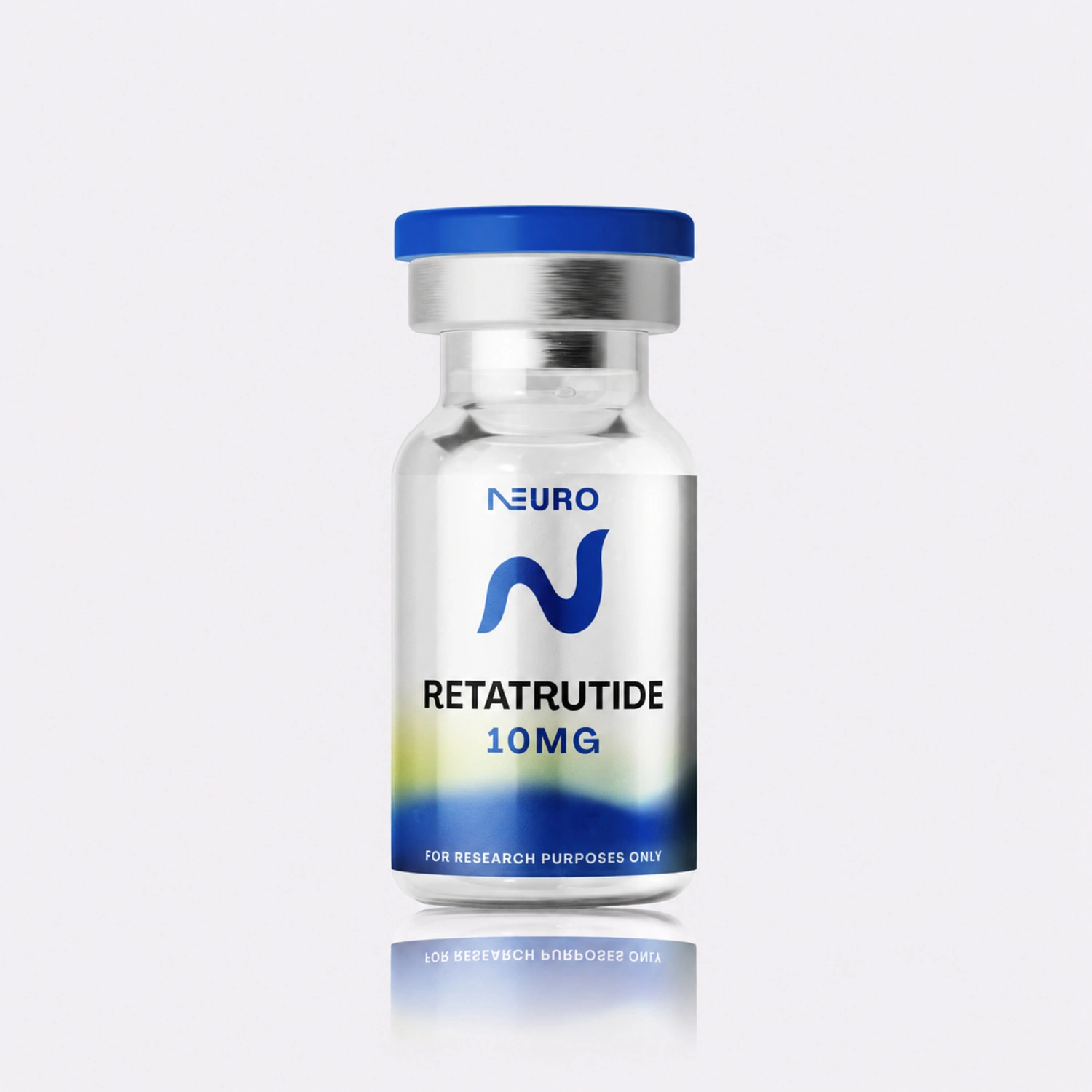
Retatrutide 10mg For Sale
Retatrutide (LY3437943) is an investigational peptide originally developed by Eli Lilly. It is known as a triple hormone receptor agonist because a single molecule activates the GIP, GLP-1, and glucagon receptors.
Researchers are studying this three-receptor mechanism to better understand metabolic signaling, glucose regulation, energy balance, appetite-related pathways, and body-weight regulation.
Retatrutide has progressed through Phase 2 and Phase 3 clinical research. In 2026, Eli Lilly reported results from multiple Phase 3 studies within its TRIUMPH development program. However, retatrutide remains investigational and has not been approved by the FDA or any other regulatory agency for human use.
Researchers can buy retatrutide 10mg online from Neuro Peptides for laboratory research purposes only.
Research Use Only: This product is not intended for human or veterinary use, diagnosis, treatment, prevention, or consumption.
Retatrutide Product Overview
| Specification |
Details |
| Product Name |
Retatrutide |
| Research Name |
LY3437943 |
| Compound Type |
Synthetic research peptide |
| Receptor Activity |
GIP, GLP-1, and glucagon receptor agonist |
| Research Classification |
Triple hormone receptor agonist |
| Development Status |
Investigational |
| Clinical Development |
Phase 3 research program |
| Developer |
Eli Lilly and Company |
| Product Form |
Lyophilized research material |
| Intended Use |
Laboratory research only |
| Human Use |
Not approved |
| Price |
$80 |
What Is Retatrutide?
Retatrutide is a synthetic peptide developed to activate three metabolic hormone receptors at the same time:
- GIP receptor
- GLP-1 receptor
- Glucagon receptor
This is the main feature that separates retatrutide from single-receptor compounds such as semaglutide and dual-receptor compounds such as tirzepatide.
Instead of studying only one signaling pathway, researchers can use retatrutide to investigate how simultaneous activity across GIP, GLP-1, and glucagon receptor systems influences metabolic processes.
A Phase 2 study published in The New England Journal of Medicine described retatrutide as an agonist of all three receptors.
How Does Retatrutide Work?
Retatrutide produces its biological activity through three receptor pathways rather than one.
1. GLP-1 Receptor Activity
GLP-1 is an incretin hormone involved in glucose regulation, insulin signaling, gastric function, and appetite-related pathways.
Researchers study GLP-1 receptor activation to understand how this signaling system affects nutrient intake and metabolic regulation.
2. GIP Receptor Activity
GIP, or glucose-dependent insulinotropic polypeptide, is another incretin hormone.
GIP receptor signaling is involved in glucose-dependent insulin secretion and broader metabolic processes. Retatrutide combines GIP receptor activity with GLP-1 and glucagon receptor activation within the same molecule.
3. Glucagon Receptor Activity
The addition of glucagon receptor activity is one of the main characteristics that distinguishes retatrutide from many earlier incretin-based compounds.
Glucagon signaling is involved in glucose metabolism and energy expenditure. Researchers are investigating how this pathway interacts with GLP-1 and GIP activity when all three receptors are activated together.
Retatrutide Receptor Activity at a Glance
| Receptor |
Retatrutide Activity |
Main Research Interest |
| GLP-1 |
Agonist |
Appetite, glucose regulation, metabolic signaling |
| GIP |
Agonist |
Incretin signaling and glucose-dependent insulin activity |
| Glucagon |
Agonist |
Energy expenditure and metabolic regulation |
The combined activation of these receptors is why retatrutide is commonly referred to as a triple receptor agonist.
Retatrutide Research
Retatrutide has been investigated across several areas of metabolic research, including obesity, type 2 diabetes, liver fat, and related metabolic conditions.
It is important to distinguish these clinical studies from the Neuro Peptides research product. Published clinical trials evaluated pharmaceutical retatrutide supplied within controlled research protocols. The Neuro Peptides product is sold only as a laboratory research material.
Retatrutide Phase 2 Obesity Research
One of the most widely cited retatrutide studies was a randomized Phase 2 trial published in The New England Journal of Medicine in 2023.
The study included 338 adults with obesity or overweight with a weight-related condition. Participants received different investigational retatrutide doses or placebo for 48 weeks.
At week 48, the reported average body-weight changes were:
| Study Group |
Body-Weight Change |
| Retatrutide 1 mg |
-8.7% |
| Retatrutide 4 mg |
-17.1% |
| Retatrutide 8 mg |
-22.8% |
| Retatrutide 12 mg |
-24.2% |
| Placebo |
-2.1% |
These results were obtained in a controlled clinical trial and should not be interpreted as expected outcomes from research-grade material.
Retatrutide Phase 3 Research in 2026
Retatrutide has since advanced into a large Phase 3 clinical development program.
As of September 2026, Eli Lilly continues to describe retatrutide as an investigational triple GIP, GLP-1, and glucagon receptor agonist. It has not yet received regulatory approval.
TRIUMPH-1
TRIUMPH-1 evaluated retatrutide in adults with obesity or overweight and at least one weight-related condition without diabetes.
In May 2026, Lilly reported that participants receiving the investigational 12 mg dose had an average body-weight reduction of 28.3% at 80 weeks, compared with 2.2% for placebo under the study’s efficacy estimand.
TRIUMPH-2
TRIUMPH-2 studied adults with obesity or overweight and type 2 diabetes.
Lilly reported an average body-weight reduction of up to 20.8% at 80 weeks with the investigational 12 mg dose, compared with 4.0% for placebo.
TRIUMPH-3
TRIUMPH-3 evaluated adults with severe obesity and established cardiovascular disease, with or without type 2 diabetes.
At 80 weeks, Lilly reported an average body-weight reduction of 22.6% with the investigational 12 mg dose compared with 3.2% for placebo.
These are clinical-development findings. Retatrutide remains investigational, and Lilly has stated that it plans to submit a Biologics License Application to the FDA in the first quarter of 2027.
Retatrutide and Type 2 Diabetes Research
Retatrutide has also been studied in participants with type 2 diabetes.
A randomized Phase 2 trial published in The Lancet evaluated retatrutide against placebo and an active comparator in adults with type 2 diabetes.
Researchers examined outcomes including:
- HbA1c
- fasting glucose
- body weight
- metabolic markers
- safety and tolerability
The study reported dose-dependent changes in glycemic and body-weight outcomes, providing further evidence for continued investigation of retatrutide’s GIP, GLP-1, and glucagon receptor activity.
Why Is Retatrutide Important in Metabolic Research?
Retatrutide has attracted significant research interest because it combines three receptor activities within a single molecule.
Researchers can study how these pathways interact rather than examining each signaling system separately.
Current areas of scientific interest include:
- GIP receptor signaling
- GLP-1 receptor signaling
- glucagon receptor signaling
- incretin biology
- glucose metabolism
- energy expenditure
- appetite-related signaling
- metabolic regulation
- adipose tissue research
- liver-fat metabolism
This multi-receptor profile makes retatrutide an important investigational compound in modern metabolic research.
Retatrutide vs Semaglutide
Retatrutide and semaglutide are not the same compound.
The main difference is their receptor activity.
| Feature |
Retatrutide |
Semaglutide |
| GLP-1 Receptor |
Yes |
Yes |
| GIP Receptor |
Yes |
No |
| Glucagon Receptor |
Yes |
No |
| Receptor Strategy |
Triple agonist |
Single GLP-1 agonist |
| Regulatory Status |
Investigational |
Approved for specific indications |
Semaglutide primarily works through GLP-1 receptor activation. Retatrutide combines GLP-1, GIP, and glucagon receptor activity.
Buy Retatrutide for Laboratory Research
Researchers looking to buy retatrutide online can order research-grade retatrutide from Neuro Peptides for laboratory research purposes only.
Retatrutide purchased from Neuro Peptides is not a pharmaceutical product and should not be represented or used as an alternative to the investigational retatrutide being evaluated in Eli Lilly clinical trials.
When purchasing any research peptide, researchers should review available product specifications and batch documentation before beginning laboratory work.
Retatrutide Storage and Handling
Retatrutide should be handled according to the storage information supplied with the specific research product and its accompanying documentation.
As with other lyophilized research peptides, the material should be protected from unnecessary exposure to heat, moisture, and light. Researchers should follow appropriate laboratory handling procedures and the storage requirements specified for the individual batch.
Is Retatrutide FDA Approved?
No, as of September 2026, retatrutide has not been approved by the FDA or any other regulatory authority. Eli Lilly continues to classify it as an investigational molecule being evaluated in clinical trials.
This distinction is important. Research-grade retatrutide offered for laboratory investigation is not an FDA-approved medication and should not be marketed as one.
Research Use Only
Retatrutide sold by Neuro Peptides is intended strictly for laboratory research purposes.
It is:
- Not for human consumption
- Not for veterinary use
- Not intended for self-administration
- Not intended to diagnose any disease
- Not intended to treat or cure any medical condition
- Not intended to prevent disease
- Not sold as a prescription or pharmaceutical product
Only qualified researchers should handle research materials using appropriate laboratory procedures.
Frequently Asked Questions
What is retatrutide?
Retatrutide, also known as LY3437943, is an investigational peptide that activates the GIP, GLP-1, and glucagon receptors. Because it acts on three receptor systems, it is described as a triple hormone receptor agonist.
Why is retatrutide called a triple agonist?
Retatrutide activates three receptors: GIP, GLP-1, and glucagon. This three-receptor activity is the reason researchers refer to it as a triple agonist.
Is retatrutide the same as semaglutide?
No. Semaglutide primarily activates GLP-1 receptors. Retatrutide activates GLP-1, GIP, and glucagon receptors.
Is retatrutide FDA approved?
No. Retatrutide remains an investigational compound as of September 2026. It has not been approved by the FDA or any other regulatory authority.
What is LY3437943?
LY3437943 is the research and development designation for retatrutide.
Can researchers buy retatrutide online?
Neuro Peptides lists retatrutide for purchase as a laboratory research product only. It is not sold for human or veterinary use.
What is retatrutide being researched for?
Published and ongoing studies have investigated retatrutide in areas including obesity, type 2 diabetes, metabolic regulation, liver fat, cardiovascular-related populations, and other metabolic conditions.
References
- Jastreboff AM, Kaplan LM, Frías JP, et al. Triple-Hormone-Receptor Agonist Retatrutide for Obesity: A Phase 2 Trial. New England Journal of Medicine. 2023;389:514-526. DOI: 10.1056/NEJMoa2301972.
- Rosenstock J, Frías J, Jastreboff AM, et al. Retatrutide, a GIP, GLP-1 and glucagon receptor agonist, for people with type 2 diabetes. The Lancet. 2023;402:529-544.
- Sanyal AJ, Kaplan LM, Frias JP, et al. Triple hormone receptor agonist retatrutide for metabolic dysfunction-associated steatotic liver disease: a randomized phase 2a trial. Nature Medicine. 2024;30:2037-2048.
- Eli Lilly and Company. What to Know About Retatrutide. Updated July 2026.
- Eli Lilly and Company. TRIUMPH-1 Phase 3 Results. May 21, 2026.
- Eli Lilly and Company. TRIUMPH-2 and TRIUMPH-3 Phase 3 Results. July 23, 2026.