
Buy Tirzepatide 20mg
Tirzepatide 20mg For Sale Tirzepatide 20mg is available at Neuro Peptides for laboratory and scientific research…
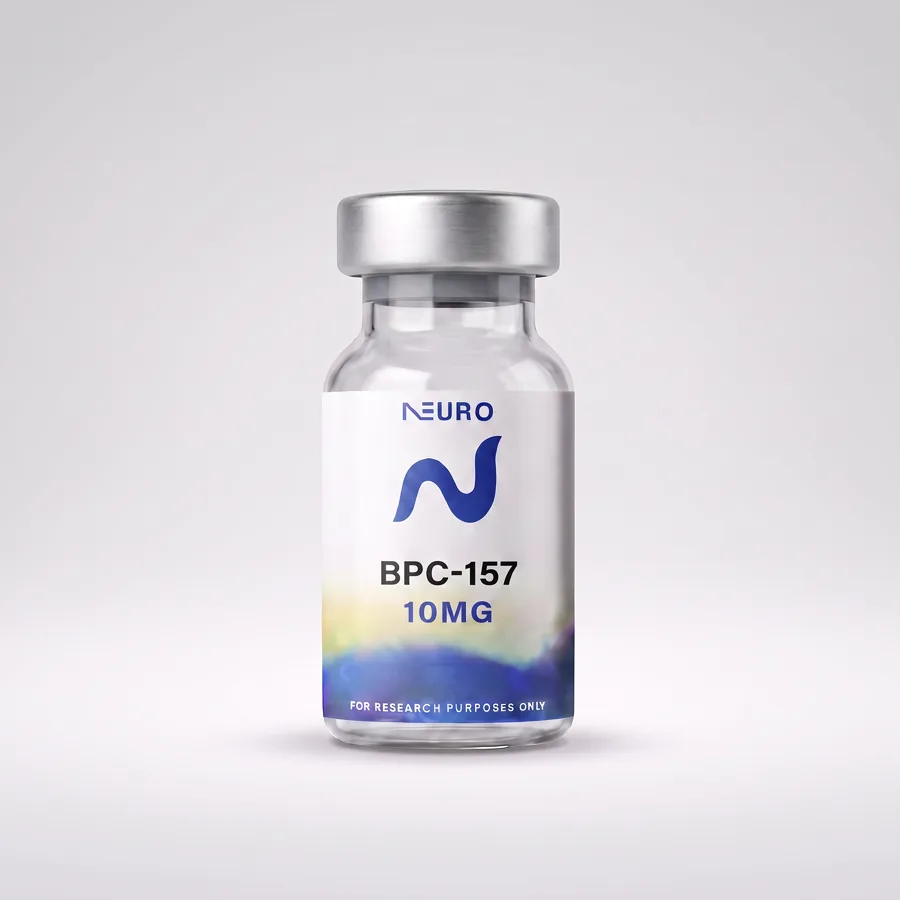
20 in stock
Researchers looking to buy BPC-157 10mg can find research-grade BPC-157 at Neuro Peptides. BPC-157, also known as Body Protection Compound-157, is a synthetic pentadecapeptide consisting of 15 amino acids and is widely investigated in preclinical research involving gastrointestinal biology, angiogenic signaling, fibroblast migration, connective-tissue models, and cellular responses to injury.
The peptide corresponds to the amino-acid sequence Gly-Glu-Pro-Pro-Pro-Gly-Lys-Pro-Ala-Asp-Asp-Ala-Gly-Leu-Val (GEPPPGKPADDAGLV) and was developed from research involving a protective compound associated with human gastric juice.
BPC-157 has attracted scientific attention because experimental studies have reported activity involving several biological pathways, including VEGFR2-Akt-eNOS signaling, nitric oxide regulation, FAK/paxillin signaling, growth-factor-associated pathways, and cellular migration.
Neuro Peptides supplies BPC-157 10mg as a lyophilized research material with third-party testing and batch-specific Certificate of Analysis documentation available.
10mg | Third-Party Tested | COA Available | Lyophilized | Research Use Only
BPC-157 10mg is intended strictly for laboratory research and is not intended for human or veterinary use.
BPC-157 is a synthetic peptide composed of 15 amino acids.
Its sequence is:
Gly-Glu-Pro-Pro-Pro-Gly-Lys-Pro-Ala-Asp-Asp-Ala-Gly-Leu-Val
or:
GEPPPGKPADDAGLV
BPC-157 is frequently described in the scientific literature as a stable gastric pentadecapeptide because early research associated the sequence with a protective protein fraction identified in gastric juice.
Unlike many short peptides that may be rapidly degraded under certain experimental conditions, BPC-157 has been investigated for its unusual stability in gastric environments. This characteristic has contributed to scientific interest in its behavior within gastrointestinal experimental models.
Research remains predominantly preclinical, with most published evidence coming from cell-based, ex vivo, and animal models.
| Specification | Details |
|---|---|
| Product Name | BPC-157 10mg |
| Full Name | Body Protection Compound-157 |
| Alternative Name | Stable Gastric Pentadecapeptide BPC-157 |
| Quantity | 10 mg |
| Peptide Length | 15 amino acids |
| Sequence | GEPPPGKPADDAGLV |
| Molecular Formula | C62H98N16O22 |
| Molecular Weight | Approximately 1419.5 Da |
| CAS Number | 137525-51-0 |
| Product Form | Lyophilized research material |
| Appearance | White to off-white lyophilized material |
| Purity | High-Purity |
| Testing | Third-party tested |
| COA | Batch-specific Certificate of Analysis available |
| Intended Use | Laboratory research only |
| Human Use | Not intended for human use |
| Veterinary Use | Not intended for veterinary use |
The mechanism of BPC-157 has not been completely established.
Preclinical research suggests that its biological activity may involve several overlapping signaling systems rather than one single molecular target.
Among the most frequently investigated mechanisms are VEGFR2-associated angiogenic signaling, Akt/eNOS activity, nitric oxide regulation, fibroblast migration, FAK/paxillin signaling, and growth-factor-associated cellular responses.
One of the better characterized experimental mechanisms of BPC-157 involves vascular endothelial growth factor receptor 2, or VEGFR2.
Studies using endothelial cells, chick chorioallantoic membrane assays, and rat hind-limb ischemia models reported increased VEGFR2 expression and activation of the VEGFR2-Akt-eNOS signaling pathway following exposure to BPC-157.
This pathway is relevant to angiogenesis because VEGFR2 signaling helps regulate endothelial-cell behavior and blood-vessel formation.
Researchers have therefore investigated BPC-157 in laboratory models involving vascular signaling, endothelial-cell responses, and angiogenic mechanisms.
These findings are preclinical and do not establish equivalent effects in humans.
Another important area of BPC-157 research involves fibroblast migration.
In experiments involving rat Achilles tendon fibroblasts, BPC-157 increased cellular migration and spreading and was associated with increased phosphorylation of focal adhesion kinase (FAK) and paxillin.
FAK and paxillin participate in focal-adhesion signaling, which helps cells attach to extracellular structures, reorganize the cytoskeleton, and migrate.
This pathway has made BPC-157 relevant to laboratory studies examining cell migration, extracellular-matrix interactions, and connective-tissue biology.
BPC-157 has also been investigated in relation to the nitric oxide system.
Nitric oxide is an important signaling molecule involved in vascular tone, endothelial function, cellular communication, and numerous physiological processes.
Preclinical literature suggests that BPC-157 interacts with pathways associated with nitric oxide synthase and endothelial signaling.
The exact relationship remains an active area of investigation rather than a fully established molecular mechanism.
Experimental studies suggest that BPC-157 may influence several pathways associated with growth-factor signaling.
Research involving tendon fibroblasts has reported increased expression of the growth hormone receptor under specific experimental conditions.
Other studies have examined interactions involving VEGFR2 and early-growth-response signaling.
These findings make BPC-157 useful for studying how peptide exposure may influence growth-factor-associated cellular responses.
BPC-157 has a substantial preclinical literature involving gastrointestinal experimental models.
Researchers have investigated the peptide in models involving gastric mucosal integrity, intestinal permeability, gastrointestinal injury, and exposure to agents such as nonsteroidal anti-inflammatory drugs.
This research forms an important part of the historical scientific interest in BPC-157.
However, results obtained from experimental gastrointestinal models should not be interpreted as evidence that research-grade BPC-157 treats gastrointestinal disease in humans.
Angiogenesis is the biological process through which new blood vessels develop from existing vasculature.
BPC-157 has been investigated in angiogenesis models because experimental studies have demonstrated interactions with VEGFR2-associated signaling.
One frequently cited study reported increased vessel density in experimental assays and increased VEGFR2 expression in endothelial-cell and rat ischemia models.
The study also identified activation of the VEGFR2-Akt-eNOS pathway.
These findings provide researchers with a basis for examining BPC-157 in controlled laboratory studies of:
The findings remain preclinical.
BPC-157 has been investigated extensively in animal and cellular models involving tendons, ligaments, skeletal muscle, and other connective tissues.
A laboratory study using Achilles tendon fibroblasts reported increased cell migration, cell spreading, survival under oxidative stress, F-actin formation, and activation of FAK and paxillin.
These findings have led researchers to investigate BPC-157 in experimental models examining:
These observations come primarily from preclinical models and should not be presented as established therapeutic effects.
Gastrointestinal biology is one of the earliest and most extensively discussed research areas associated with BPC-157.
Experimental studies have investigated the peptide in relation to gastric mucosal integrity and gastrointestinal responses to different forms of experimental stress and injury.
Research areas include:
The ability of BPC-157 to remain stable under gastric conditions has also attracted interest in peptide stability and structure-function research.
BPC-157 10mg may be used in appropriately designed laboratory experiments across several research areas.
Researchers may investigate cellular migration, survival signaling, cytoskeletal organization, focal adhesions, and peptide-mediated cellular responses.
BPC-157 has been investigated in studies involving endothelial cells, VEGFR2 activity, Akt signaling, eNOS activation, and experimental blood-vessel formation.
Laboratory models may explore gastric mucosal signaling, intestinal epithelial responses, cytoprotective pathways, and experimental gastrointestinal injury.
Researchers may use BPC-157 in experimental models examining tendon fibroblasts, ligaments, muscle tissue, extracellular-matrix interactions, and tissue remodeling.
BPC-157 may be studied in relation to gene expression and intracellular pathways associated with VEGFR2, FAK, paxillin, nitric oxide signaling, and growth-factor responses.
Researchers can investigate how BPC-157 influences endothelial-cell behavior and vascular signaling under controlled experimental conditions.
Studies may examine concentration-dependent biological responses, peptide stability, structure-activity relationships, and interaction with cellular signaling systems.
Neuro Peptides supplies third-party tested BPC-157 10mg for laboratory research.
Independent analytical testing allows researchers to evaluate important characteristics of the material separately from the supplier’s internal quality-control procedures.
Researchers should review the documentation corresponding to the specific lot they receive because analytical results can vary between production batches.
A batch-specific Certificate of Analysis is available for BPC-157 10mg supplied by Neuro Peptides.
Depending on the testing performed, the COA may contain information including:
Researchers should refer to their batch-specific COA rather than relying exclusively on generalized product-page specifications.
High-performance liquid chromatography and mass spectrometry are commonly used to evaluate research peptides.
HPLC can be used to determine chromatographic purity by separating detectable components within a peptide sample.
The resulting purity percentage represents the relative chromatographic purity observed under the conditions of the specific assay.
Mass spectrometry can help confirm molecular identity by evaluating the mass characteristics of the peptide.
HPLC purity and mass identity provide different types of information, which is why researchers should examine the complete analytical documentation whenever available.
Appropriate storage is important for maintaining the integrity of BPC-157 during laboratory research.
Keep unopened BPC-157 10mg vials:
Frozen conditions around -20°C are commonly used for longer-term laboratory storage of lyophilized peptide preparations.
Researchers should nevertheless follow Neuro Peptides’ product-specific storage instructions and batch documentation.
Once BPC-157 is placed into solution, stability may depend on factors including:
A universal post-reconstitution shelf life should therefore not be assumed unless supported by stability data for the specific formulation.
Repeated freeze-thaw cycles should generally be minimized.
BPC-157 10mg supplied by Neuro Peptides is intended strictly for scientific and laboratory research.
It is not intended for human consumption, administration, diagnosis, treatment, disease prevention, wound healing, injury recovery, veterinary administration, or any other clinical application.
BPC-157 is not FDA-approved for human therapeutic use.
Published research involving BPC-157 remains predominantly preclinical, and animal or cell-culture findings should not be interpreted as evidence of safety or effectiveness in humans.
BPC-157 10mg is a research preparation containing 10mg of the synthetic 15-amino-acid peptide Body Protection Compound-157.
Neuro Peptides supplies BPC-157 as a lyophilized research material for controlled laboratory investigation.
BPC-157 contains 15 amino acids.
Its sequence is:
GEPPPGKPADDAGLV
BPC-157 is investigated primarily in preclinical research involving gastrointestinal biology, endothelial signaling, angiogenesis, fibroblast migration, connective-tissue models, nitric oxide-associated signaling, and cellular responses to experimental injury.
Its complete mechanism has not been established.
Preclinical studies have identified several potentially relevant pathways, including VEGFR2-Akt-eNOS signaling, FAK/paxillin signaling, nitric oxide-associated mechanisms, and growth-factor-related responses.
Preclinical experimental studies have reported increased VEGFR2 expression and activation of VEGFR2-Akt-eNOS-associated signaling following BPC-157 exposure.
These findings come from laboratory and animal models.
Yes. BPC-157 10mg supplied by Neuro Peptides is third-party tested.
Researchers can review available batch-specific analytical documentation associated with their product.
Yes. Neuro Peptides provides a batch-specific Certificate of Analysis for BPC-157 10mg.
The COA allows researchers to review available analytical results for the particular batch they receive.
The precise purity result should be verified using the batch-specific Certificate of Analysis.
If Neuro Peptides specifies ≥98% HPLC purity for the current batch, that claim should be supported directly by the corresponding analytical report.
BPC-157 has a molecular weight of approximately 1419.5 Da.
The molecular formula commonly reported for BPC-157 is C62H98N16O22.
No. BPC-157 is not FDA-approved for human therapeutic use.
The FDA has also stated that available safety information is limited and has identified potential concerns involving immunogenicity and peptide-related impurities in compounded BPC-157 products.
No. The evidence base remains predominantly preclinical.
Most published research involves animal models, cell cultures, or other experimental systems, while controlled human evidence remains very limited.
No. BPC-157 10mg supplied by Neuro Peptides is intended strictly for laboratory research and is not intended for human or veterinary use.
Researchers can buy BPC-157 10mg from Neuro Peptides for laboratory research.
The product is supplied as lyophilized research material with third-party testing and batch-specific Certificate of Analysis documentation available.
BPC-157 is a synthetic 15-amino-acid research peptide that continues to attract scientific interest because of its activity across several preclinical experimental systems.
Research has particularly examined VEGFR2-Akt-eNOS signaling, FAK/paxillin-mediated cellular migration, nitric oxide-associated mechanisms, endothelial biology, gastrointestinal cytoprotection, and connective-tissue models.
Despite substantial preclinical research, clinical evidence remains limited, and findings from animal or laboratory models should not be interpreted as established therapeutic effects in humans.
Neuro Peptides supplies BPC-157 10mg as a lyophilized research material with third-party testing and batch-specific Certificate of Analysis documentation available.
For laboratory research only. Not intended for human or veterinary use.
All research peptides are for laboratory use only
Certificate of Analysis
Chemical properties

Tirzepatide 20mg For Sale Tirzepatide 20mg is available at Neuro Peptides for laboratory and scientific research…
$ 104 / vial
View Details → Buy Tirzepatide 20mg
Buy Retatrutide 20mg Retatrutide (LY3437943) is an investigational peptide developed by Eli Lilly. It has attracted…
$ 145 / vial
View Details → Buy Retatrutide 20mg
Retatrutide 10mg For Sale Retatrutide (LY3437943) is an investigational peptide originally developed by Eli Lilly. It…
$ 80 / vial
View Details → Buy Retatrutide 10mg
Thymosin Alpha-1 5mg For Sale Researchers looking to buy Thymosin Alpha-1 5mg can find research-grade, third-party…
$ 36 / vial
View Details → Buy Thymosin Alpha-1 5mg