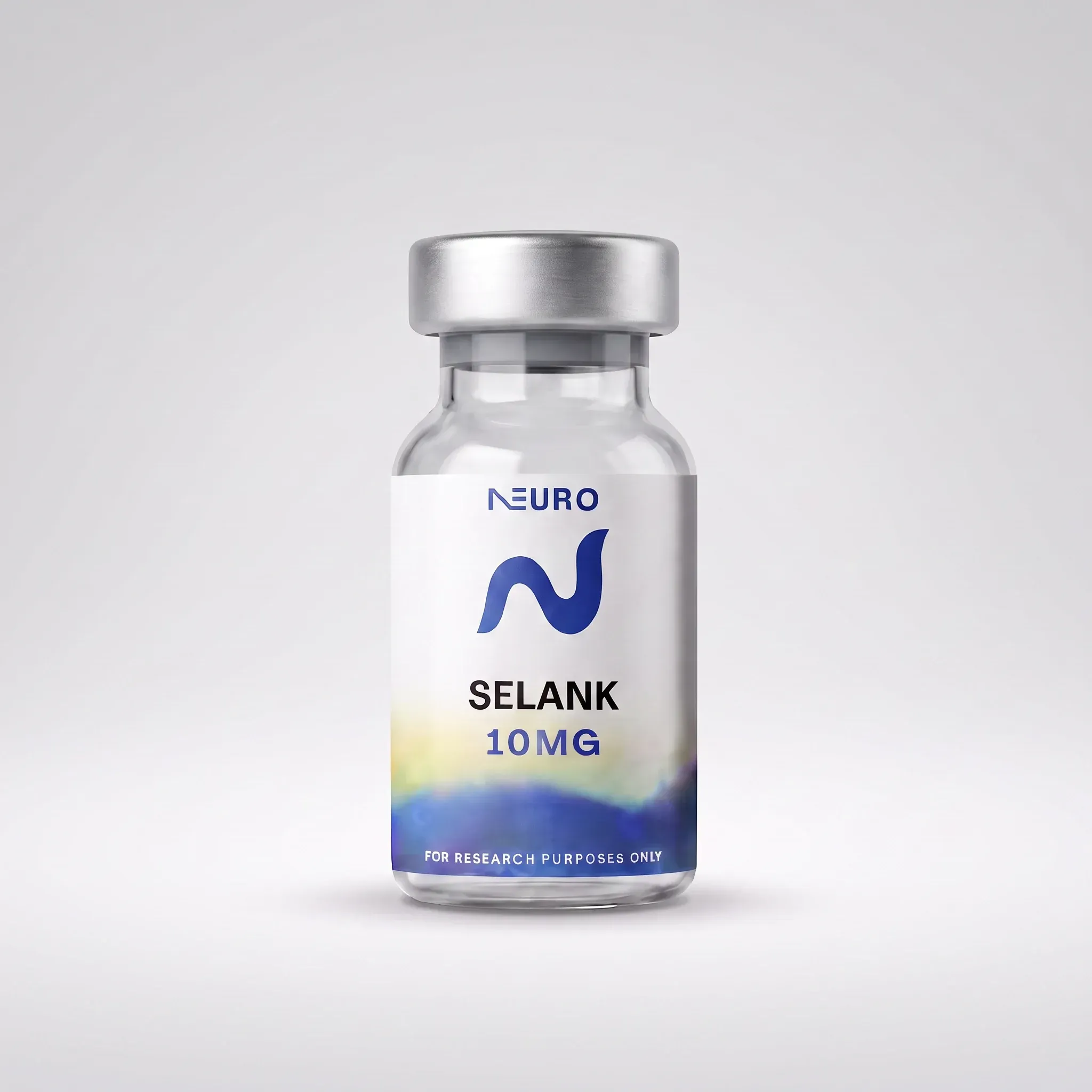
Selank 10mg For Sale
Researchers looking to buy Selank 10mg can find research-grade Selank at Neuro Peptides. Selank is a synthetic regulatory heptapeptide composed of seven amino acids and developed as an analog of the naturally occurring peptide tuftsin.
Selank contains the amino-acid sequence Thr-Lys-Pro-Arg-Pro-Gly-Pro (TKPRPGP). Its structure incorporates the four-amino-acid tuftsin sequence, Thr-Lys-Pro-Arg, followed by the tripeptide Pro-Gly-Pro.
The peptide has attracted significant scientific interest because experimental studies have investigated its interactions with GABAergic neurotransmission, neurotransmitter-associated gene expression, brain-derived neurotrophic factor (BDNF), monoamine signaling, and enkephalin metabolism.
These characteristics make Selank relevant to laboratory research involving neuropeptide biology, molecular neuroscience, receptor signaling, gene expression, peptide metabolism, and cellular communication.
Neuro Peptides supplies Selank 10mg as a lyophilized research peptide with third-party testing and batch-specific Certificate of Analysis documentation available.
Selank 10mg is intended strictly for scientific and laboratory research and is not intended for human or veterinary use.
What Is Selank?
Selank is a synthetic heptapeptide consisting of seven amino acids:
Thr-Lys-Pro-Arg-Pro-Gly-Pro
or:
TKPRPGP
Selank was developed from the naturally occurring immunoregulatory peptide tuftsin.
Tuftsin consists of four amino acids:
Thr-Lys-Pro-Arg
During development of Selank, the Pro-Gly-Pro sequence was added to the C-terminal end of the tuftsin structure.
This produces the seven-amino-acid peptide:
Thr-Lys-Pro-Arg-Pro-Gly-Pro
Experimental research suggests that adding the Pro-Gly-Pro sequence influences the peptide’s metabolic characteristics and contributes to the properties that distinguish Selank from the original tuftsin molecule.
Selank has subsequently been investigated across several areas of experimental neuroscience, including GABA-associated signaling, gene regulation, neurotrophic signaling, peptide metabolism, and monoaminergic systems.
Selank 10mg Specifications
| Specification |
Details |
| Product Name |
Selank 10mg |
| Peptide Name |
Selank |
| Alternative Names |
Selanc, TP-7 |
| Quantity |
10 mg |
| Peptide Type |
Synthetic regulatory heptapeptide |
| Peptide Length |
7 amino acids |
| Amino-Acid Sequence |
Thr-Lys-Pro-Arg-Pro-Gly-Pro |
| Short Sequence |
TKPRPGP |
| Molecular Formula |
C33H57N11O9 |
| Molecular Weight |
Approximately 751.9 g/mol |
| CAS Number |
129954-34-3 |
| PubChem CID |
11765600 |
| Appearance |
White to off-white lyophilized material |
| Product Form |
Lyophilized research peptide |
| Purity |
Refer to batch-specific COA |
| Testing |
Third-party tested |
| COA |
Batch-specific Certificate of Analysis available |
| Intended Use |
Laboratory research only |
| Human Use |
Not intended for human use |
| Veterinary Use |
Not intended for veterinary use |
Selank Mechanism of Action in Experimental Research
The molecular activity of Selank has not been reduced to a single receptor or signaling pathway.
Instead, experimental studies suggest that Selank may influence several interconnected biological systems.
Research has particularly focused on:
- GABAergic neurotransmission
- Neurotransmission-related gene expression
- BDNF-associated signaling
- Enkephalin metabolism
- Peptide-degrading enzymes
- Serotonergic signaling
- Noradrenergic signaling
- Broader neuropeptide-mediated cellular communication
These mechanisms remain areas of active investigation.
1. Selank and GABAergic Signaling
One of the best-characterized areas of Selank research involves the gamma-aminobutyric acid (GABA) system.
GABA is an important inhibitory neurotransmitter in the mammalian central nervous system.
Experimental research suggests that Selank may influence GABAergic signaling without simply functioning as a conventional GABA receptor agonist.
Radioligand studies have examined Selank’s effect on GABA binding and suggest that the peptide may behave as a positive allosteric modulator of GABA-associated receptor activity under specific experimental conditions.
This means researchers are particularly interested in whether Selank modifies how GABA-associated signaling systems respond rather than directly replacing GABA itself.
The interaction remains mechanistically complex and continues to be studied.
2. Selank and GABA-Related Gene Expression
Selank has also been investigated for its effect on genes involved in neurotransmission.
In experimental studies using rat frontal cortex tissue, researchers analyzed dozens of genes associated with:
- GABA receptors
- Neurotransmitter transporters
- Ion channels
- Dopamine receptors
- Serotonin receptors
- Other neurotransmission-related proteins
Selank exposure was associated with changes in the expression of multiple genes involved in neurotransmission.
Researchers also observed similarities between some gene-expression responses produced by Selank and those associated with GABA.
These findings support continued investigation into GABAergic gene regulation as one potential component of Selank’s molecular activity.
3. Selank and BDNF Research
Another important area of Selank research involves brain-derived neurotrophic factor (BDNF).
BDNF is a signaling protein involved in neuronal biology, synaptic plasticity, cellular adaptation, and numerous processes within the nervous system.
Animal studies have examined whether Selank modifies BDNF concentrations within brain structures such as the hippocampus and frontal cortex under specific experimental conditions.
These findings have led researchers to investigate whether neurotrophin-associated signaling contributes to some of the biological responses observed following Selank exposure.
However, the relationship between Selank and BDNF depends on the experimental model and should not be interpreted as a single established pathway.
4. Selank and Enkephalin Metabolism
Selank has also been investigated for its interaction with enzymes responsible for degrading enkephalins.
Enkephalins are endogenous regulatory peptides that participate in cellular signaling within several biological systems.
Once released, enkephalins can be broken down by different peptidases.
Experimental research has reported that Selank can inhibit certain enkephalin-degrading enzymes under laboratory conditions.
This has led researchers to examine whether changes in endogenous regulatory-peptide metabolism contribute to Selank’s biological activity.
Rather than functioning simply through direct receptor binding, Selank may therefore influence biological signaling indirectly by altering the degradation of other regulatory peptides.
5. Selank and Monoamine Signaling
Experimental research has also examined Selank in relation to monoaminergic neurotransmitter systems.
These include signaling involving:
- Serotonin
- Noradrenaline
- Dopamine-associated pathways
Animal studies have reported changes in serotonin and noradrenaline-associated activity under particular experimental conditions following Selank exposure.
Other research examining dopamine-associated responses suggests that Selank’s activity may involve indirect modulation rather than conventional direct binding to dopamine receptors.
These observations make Selank relevant for research examining interactions between peptide signaling and monoaminergic neurotransmission.
6. Selank as a Tuftsin Analog
Understanding Selank’s structure is important for understanding its research applications.
Selank was developed from tuftsin, an endogenous tetrapeptide with the sequence:
Thr-Lys-Pro-Arg
Tuftsin has historically been investigated for its involvement in immune-cell and peptide signaling.
Selank retains this four-amino-acid sequence but adds:
Pro-Gly-Pro
to create:
Thr-Lys-Pro-Arg-Pro-Gly-Pro
The resulting heptapeptide has therefore attracted interest not only in neuroscience but also in studies examining how structural modifications of naturally occurring regulatory peptides affect stability and biological activity.
Selank Research Applications
Selank 10mg may be used in appropriately designed laboratory investigations across several scientific disciplines.
Neuropeptide Research
Selank provides researchers with a model for studying how short regulatory peptides influence cellular signaling and neurotransmission.
Scientists may compare Selank with tuftsin or other regulatory peptides to examine how peptide structure affects biological activity.
GABAergic Signaling Research
Selank is relevant to experiments investigating:
- GABA-associated receptor activity
- Allosteric modulation
- GABA-related gene expression
- Neurotransmitter signaling
- Receptor-associated cellular responses
Gene-Expression Research
Researchers may investigate changes in transcription associated with Selank exposure.
Of particular interest are genes associated with:
- GABA receptors
- Neurotransmitter receptors
- Ion channels
- Neurotransmitter transport
- Cellular signaling
Neurotrophic Factor Research
Selank has been examined in experimental studies involving BDNF.
Researchers may use appropriate models to explore interactions between regulatory peptides and neurotrophic signaling.
Peptide Metabolism Research
The reported interaction between Selank and enkephalin-degrading enzymes makes the peptide relevant to studies investigating:
- Peptidases
- Regulatory peptide degradation
- Enkephalin metabolism
- Peptide stability
- Peptide-peptide interactions
Monoamine Research
Selank may be studied in experimental models involving serotonin, noradrenaline, dopamine-associated pathways, and interactions between peptide and monoamine signaling systems.
Molecular Neuroscience
Researchers may incorporate Selank into experimental models examining intracellular responses to regulatory neuropeptides.
Potential endpoints include receptor-associated signaling, gene expression, neurotrophic factors, and neurotransmitter-associated molecular pathways.
Peptide Structure-Activity Research
Because Selank combines the tuftsin sequence with a Pro-Gly-Pro extension, it provides a useful experimental structure for studying how amino-acid modifications affect peptide metabolism and biological activity.
Selank 10mg Third-Party Testing
Neuro Peptides provides third-party tested Selank 10mg for laboratory research.
Independent analytical testing gives researchers additional information about the identity and purity of the supplied material rather than relying exclusively on internal supplier specifications.
Researchers should review documentation corresponding to the specific batch used in their experiments.
Selank Certificate of Analysis
A batch-specific Certificate of Analysis (COA) is available for Selank 10mg supplied by Neuro Peptides.
Depending on the analytical methods performed for a particular batch, the COA may include:
- Product identity
- Lot or batch number
- HPLC purity
- Mass spectrometry results
- Peptide content
- Test date
- Analytical methodology
- Additional available quality-control information
Researchers should always refer to the Certificate of Analysis corresponding to their specific lot.
HPLC and Mass Spectrometry Testing
HPLC
High-performance liquid chromatography can be used to separate components within a peptide sample and determine chromatographic purity.
The resulting purity percentage represents the relative proportion of the principal detectable peptide peak under the analytical conditions used.
Mass Spectrometry
Mass spectrometry provides complementary information by examining molecular mass.
This can help confirm whether the analyzed material is consistent with the expected molecular identity of Selank.
For research-quality evaluation, purity and molecular identity should be considered separately rather than treating an HPLC percentage alone as complete confirmation of peptide identity.
Selank Storage Instructions
Appropriate storage helps maintain the integrity of Selank 10mg during laboratory research.
Storage of Lyophilized Selank
Keep unopened Selank 10mg:
- Tightly sealed
- Protected from moisture
- Protected from direct light
- Away from excessive heat
- Protected from repeated temperature fluctuations
Frozen storage around -20°C is commonly specified for longer-term storage of lyophilized research peptide preparations.
Researchers should nevertheless follow Neuro Peptides’ product-specific storage documentation and any batch-specific stability information available.
Storage After Preparation
The stability of Selank in a prepared research solution can depend on:
- Solvent or buffer composition
- Peptide concentration
- pH
- Storage temperature
- Container material
- Duration of storage
- Microbial contamination
- Freeze-thaw exposure
Researchers should therefore follow a validated laboratory protocol or product-specific stability documentation.
A universal post-reconstitution expiration period should not be stated unless it is supported by stability data for the specific formulation.
Repeated freeze-thaw cycles should generally be minimized.
Research Disclaimer
Selank 10mg supplied by Neuro Peptides is intended strictly for scientific and laboratory research.
It is not intended for human consumption, administration, diagnosis, treatment, disease prevention, veterinary use, or other clinical applications.
Neuro Peptides research materials are not marketed as pharmaceutical drugs, nutritional supplements, foods, cosmetics, or medical devices.
Frequently Asked Questions
What is Selank 10mg?
Selank 10mg is a research preparation containing the synthetic seven-amino-acid peptide Thr-Lys-Pro-Arg-Pro-Gly-Pro.
Neuro Peptides supplies Selank as a lyophilized research material intended for controlled laboratory investigations.
How many amino acids does Selank contain?
Selank contains seven amino acids.
Its sequence is:
Thr-Lys-Pro-Arg-Pro-Gly-Pro
or:
TKPRPGP
Is Selank derived from tuftsin?
Selank was developed as a synthetic analog of tuftsin.
Tuftsin contains the sequence Thr-Lys-Pro-Arg, while Selank adds Pro-Gly-Pro to the C-terminal end, producing the seven-amino-acid sequence TKPRPGP.
What is Selank studied for?
Selank is investigated in research involving GABAergic neurotransmission, neurotransmission-related gene expression, BDNF-associated signaling, enkephalin metabolism, monoamine systems, peptide degradation, and regulatory neuropeptide biology.
Does Selank interact with the GABA system?
Experimental research suggests that Selank influences GABA-associated signaling.
Studies have reported effects on GABA binding and the expression of genes involved in GABAergic neurotransmission.
The precise molecular mechanism remains an active area of research.
Does Selank affect BDNF?
Animal studies have investigated Selank in relation to brain-derived neurotrophic factor concentrations within brain structures including the hippocampus and frontal cortex.
The observed effects depend on the specific experimental model.
Is Selank 10mg third-party tested?
Yes. Neuro Peptides supplies third-party tested Selank 10mg.
Researchers can review available analytical documentation associated with their specific batch.
Is a COA available for Selank 10mg?
Yes. Neuro Peptides provides a batch-specific Certificate of Analysis for Selank 10mg.
Researchers can use the COA to review available analytical results relating to identity, purity, and other tested specifications.
What is the purity of Selank 10mg?
The precise purity of each Selank 10mg batch should be confirmed using its batch-specific Certificate of Analysis.
HPLC testing provides information regarding chromatographic purity, while mass spectrometry can be used to support molecular identity.
What is Selank’s molecular weight?
The molecular weight of Selank is approximately 751.9 g/mol.
What is the molecular formula of Selank?
The molecular formula of Selank is:
C33H57N11O9
What is the CAS number for Selank?
The commonly referenced CAS number for Selank is:
129954-34-3
What form is Selank 10mg supplied in?
Neuro Peptides supplies Selank 10mg as a lyophilized research material in a laboratory vial.
How should Selank 10mg be stored?
Keep lyophilized Selank protected from light, moisture, excessive heat, and repeated temperature fluctuations.
Frozen storage at approximately -20°C is commonly used for longer-term laboratory storage of comparable peptide preparations. Product-specific storage documentation should take priority.
Can Selank 10mg be used by humans?
No. Selank 10mg supplied by Neuro Peptides is intended strictly for laboratory research and is not intended for human or veterinary use.
Where can researchers buy Selank 10mg?
Researchers can buy Selank 10mg from Neuro Peptides for laboratory research.
The product is supplied as a lyophilized research peptide with third-party testing and batch-specific Certificate of Analysis documentation available.
Final Thoughts
Selank is a synthetic seven-amino-acid regulatory peptide derived from the tuftsin sequence and extended with the Pro-Gly-Pro tripeptide.
Its distinct molecular structure has supported research across several areas of experimental neuroscience and peptide biology.
Scientific investigations have particularly examined GABAergic neurotransmission, neurotransmission-related gene expression, BDNF-associated pathways, enkephalin-degrading enzymes, monoaminergic systems, and regulatory peptide metabolism.
These characteristics make Selank 10mg relevant to controlled laboratory investigations involving neuropeptide signaling, molecular neuroscience, gene regulation, peptide metabolism, and structure-activity relationships.
Neuro Peptides supplies Selank 10mg as a lyophilized research material