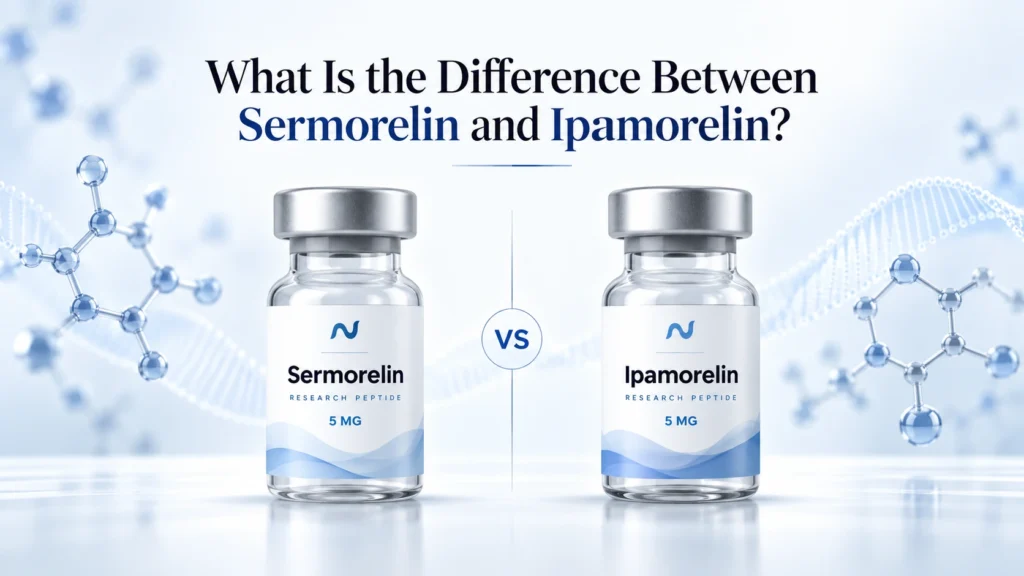
Sermorelin and ipamorelin are synthetic peptides studied for their ability to stimulate growth hormone (GH) release. However, sermorelin acts through the growth hormone–releasing hormone (GHRH) receptor, while ipamorelin activates the growth hormone secretagogue receptor (GHS-R1a). Their molecular structures, signaling pathways, and research histories are distinct.
Understanding these differences helps researchers interpret experimental findings and distinguish established evidence from proposed biological effects.
What Is Sermorelin?
Sermorelin is a synthetic 29-amino-acid peptide corresponding to the N-terminal portion of human growth hormone–releasing hormone. Often described as GHRH (1–29)-NH₂, it mimics part of the naturally occurring hormone that signals the pituitary gland to release growth hormone. For a closer look, see our guide to tesamorelin vs. sermorelin.
Its research applications center on GHRH-mediated signaling, pituitary function, and the regulation of GH secretion. By binding to GHRH receptors, sermorelin activates intracellular signaling involved in growth hormone release.
Sermorelin also has a documented clinical history. The US Food and Drug Administration (FDA) previously approved Geref products for specific pediatric growth-hormone-deficiency and diagnostic indications. Those products were later discontinued. In 2013, the FDA determined that they had not been withdrawn for reasons of safety or effectiveness. This historical decision does not mean every sermorelin formulation is currently approved.
What Is Ipamorelin?
Ipamorelin is a synthetic pentapeptide composed of five amino-acid residues. Its sequence is commonly represented as Aib-His-D-2-Nal-D-Phe-Lys-NH₂. Aib is alpha-aminoisobutyric acid, while 2-Nal refers to 2-naphthylalanine. These modified residues distinguish ipamorelin from naturally occurring peptide sequences.
Unlike sermorelin, ipamorelin does not mimic the GHRH sequence. Instead, it acts as a growth hormone secretagogue by activating GHS-R1a, a receptor also known as the ghrelin receptor.
In their original study, Raun and colleagues characterized ipamorelin as a selective growth hormone secretagogue in experimental research. The findings helped establish its pharmacological profile, but they did not demonstrate long-term safety or broad clinical effectiveness in humans.
Sermorelin vs. Ipamorelin: Key Molecular Differences
Although both peptides can stimulate growth hormone release, their molecular structures and primary receptor targets differ.
| Feature | Sermorelin | Ipamorelin |
| Peptide length | 29 amino acids | 5 amino acids |
| Molecular design | Fragment of GHRH | Synthetic growth hormone secretagogue |
| Primary receptor | GHRH receptor | GHS-R1a (ghrelin receptor) |
| Main research focus | GHRH signaling and pituitary GH release | Secretagogue-receptor signaling and GH release |
| Structural characteristic | Resembles the N-terminal region of GHRH | Contains modified amino-acid residues |
| Key evidence limitation | Historical approval does not establish every current use | Limited human safety and efficacy evidence |
The key distinction is the receptor each peptide activates. Their shared effect on growth hormone release does not make them interchangeable or prove that they produce identical physiological responses.
How Do Their Mechanisms of Action Differ?
- Sermorelin and GHRH receptor signaling
Sermorelin binds to GHRH receptors, which are expressed on growth hormone–producing cells in the anterior pituitary. Receptor activation initiates intracellular signaling that promotes GH secretion.
This pathway is part of the body’s natural endocrine regulation. However, the resulting response can vary with factors such as age, physiological state, and pituitary function. A mechanistic explanation alone cannot establish the magnitude or clinical significance of a response in humans. This is covered further in our guide to tesamorelin vs. CJC-1295.
- Ipamorelin and the ghrelin receptor
Ipamorelin activates GHS-R1a, a receptor involved in growth hormone secretion and broader physiological signaling. The receptor is associated with ghrelin, a hormone involved in appetite regulation and other biological processes.
Research into GHS-R1a provides context for understanding ipamorelin’s activity, but receptor activation should not be equated with a proven benefit for sleep, body composition, recovery, or aging. Those outcomes require evidence from appropriately designed studies.
A review of the growth hormone secretagogue receptor and it signaling pathways describes the receptor’s broader biological roles, reinforcing why its effects should not be reduced to growth hormone release alone.
What Does the Research Show?
Research on sermorelin includes studies of pituitary function, growth hormone stimulation, and its historical diagnostic and pediatric clinical applications. These findings provide a basis for understanding its pharmacology, but they do not validate every modern claim associated with sermorelin products.
Ipamorelin has been investigated in laboratory studies and human pharmacokinetic research. Gobburu et al. examined its pharmacokinetics and growth hormone response in healthy male volunteers. Under the study’s intravenous conditions, the reported terminal half-life was approximately two hours. This result is specific to that study and should not be generalized to every formulation or route of administration.
Safety questions also remain important. The FDA has highlighted concerns about compounded ipamorelin acetate, including potential immunogenicity, peptide-related impurities, and aggregation. It also cites serious adverse events in a study involving intravenous ipamorelin for gastric motility. These findings do not establish the same risk for every preparation or route, but they underline the limits of the available safety information.
Overall, the evidence should be assessed by study type, formulation, route, and measured outcome. Findings from laboratory experiments or pharmacokinetic studies do not automatically establish clinical efficacy.
Why Do Molecular Identity and Analytical Testing Matter?
Accurate peptide research begins with confirming the identity of the material being investigated. This is particularly important for synthetic peptides containing modified residues or requiring careful characterization.
Mass spectrometry can help assess whether the measured molecular mass is consistent with the expected structure. High-performance liquid chromatography (HPLC) can provide information about chromatographic purity under the stated analytical conditions. Neither method independently proves biological activity, clinical effectiveness, or safety. Batch results for our own vials are published on batch-by-batch COA records.
Researchers should therefore review the peptide identity, analytical methods, batch or lot number, test laboratory, and reported results. A batch-specific Certificate of Analysis (COA) can support traceability, provided its findings are clearly linked to the material tested.
Conclusion
The difference between sermorelin and ipamorelin lies primarily in their molecular structures and receptor targets. Sermorelin is a 29-amino-acid fragment of GHRH that activates GHRH receptors. Ipamorelin is a five-amino-acid secretagogue that acts through GHS-R1a. We go into more detail in our guide to CJC-1295 and ipamorelin research.
Both are studied in relation to growth hormone release, but their mechanisms and evidence bases are distinct. For reliable research interpretation, investigators should evaluate the exact peptide identity, study design, analytical documentation, and limitations of the available evidence rather than assuming that a shared biological outcome establishes equivalent effects.
References
- https://www.govinfo.gov/content/pkg/FR-2013-03-04/html/2013-04827.htm
- https://pubmed.ncbi.nlm.nih.gov/9849822/
- https://pmc.ncbi.nlm.nih.gov/articles/PMC3975427/
- https://pubmed.ncbi.nlm.nih.gov/10496658/
- https://www.fda.gov/drugs/human-drug-compounding/certain-bulk-drug-substances-use-compounding-may-present-significant-safety-risks