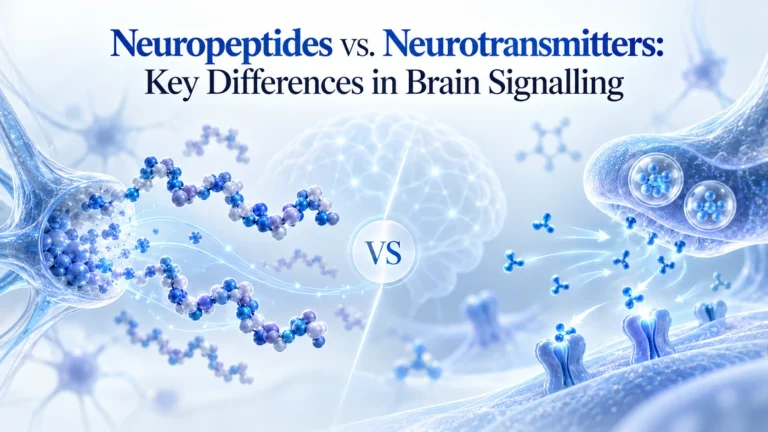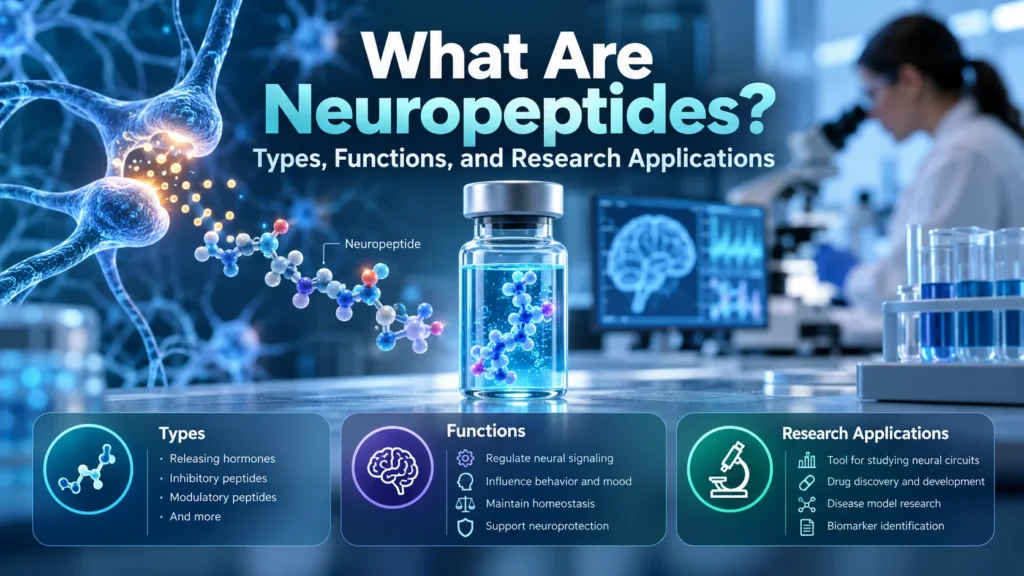
Neuropeptides are peptide molecules that are made by neurons to facilitate the process of communication within the nervous system. The difference between neuropeptides and most classical neurotransmitters is that neuropeptides are formed from large precursor proteins.
They can influence pain, appetite, stress, sleep, sensory processing, metabolism, and many other physiological processes.
According to Russo, more than 100 neuropeptides have been identified in humans, with many additional peptide signals still being investigated. For a closer look, see our guide to neuropeptides vs. neurotransmitters.
For researchers, the ability of neuropeptides to influence beyond just one synapse makes them particularly fascinating to study. Neuropeptide receptors, processing routes, and physiological functions create numerous avenues of investigation within neuroscience, pharmacology, and peptide research.
What are Neuropeptides?
Neuropeptides are signaling peptides produced and released by neurons through a regulated secretory pathway. They can act on neurons as well as peripheral target cells.
Unlike small-molecule neurotransmitters, neuropeptides are produced from larger precursor proteins. These precursors undergo enzymatic processing inside the neuron before mature peptides are packaged into large dense-core vesicles.
The NCBI Bookshelf chapter on neuropeptide function and regulation explains that neuropeptide expression and activity are regulated at several stages, including gene transcription, precursor processing, secretion, and degradation.
One precursor can also produce several biologically active peptides. This processing can vary between tissues, creating different peptide products from the same precursor protein.
How Do Neuropeptides Work?
Neuropeptides are commonly stored in dense-core vesicles and released when neurons are activated. Their release is calcium-dependent, but it often requires stronger or more sustained neuronal activity than the release of conventional neurotransmitters.
After release, neuropeptides can diffuse through extracellular spaces and act beyond the immediate synaptic junction. This broader signaling process is often described as volume transmission.
Most characterized neuropeptide receptors are G-protein-coupled receptors (GPCRs). Activation of these receptors can trigger intracellular signaling pathways that modify neuronal activity and cellular responses.
As Russo demonstrates, these characteristics help explain why neuropeptides often produce slower and more prolonged modulatory effects than classical neurotransmitters. If you are planning laboratory work, our catalog lists DSIP 10mg research vial.
Main Types of Neuropeptides
Neuropeptides belong to numerous families, and individual peptides can have several biological roles.
Substance P and Tachykinins
Substance P is a well-known member of the tachykinin family. It participates in nociception, neurogenic inflammation, vascular signaling, and gastrointestinal activity.
Kenhub’s review of neuropeptides identifies substance P as one of the major neuropeptides involved in sensory and physiological signaling.
Opioid Peptides
Endogenous opioid peptides include enkephalins, dynorphins, and β-endorphin. These peptides interact with opioid receptors and contribute to pain modulation, reward-related signaling, and other neural processes.
Their study has helped researchers understand how endogenous peptide signaling can modify sensory perception and behavior.
Neuropeptide Y
Neuropeptide Y (NPY) is one of the most abundant neuropeptides in the brain. It has been investigated extensively in relation to feeding behavior, energy homeostasis, stress responses, circadian biology, and neural activity.
According to Kenhub’s overview, NPY acts through several receptor subtypes and participates in multiple physiological pathways.
CGRP and PACAP
Calcitonin gene-related peptide (CGRP) and pituitary adenylate cyclase-activating polypeptide (PACAP) are important research subjects in sensory neuroscience and migraine biology.
Kuburas and Russo describe both peptides as multifunctional signaling molecules involved in vasodilation, nociception, and neurogenic processes associated with migraine.
Importantly, researchers continue to investigate how CGRP and PACAP differ in their receptors and signaling pathways rather than treating them as interchangeable molecules.
Oxytocin and Vasopressin
Oxytocin and vasopressin are neuropeptides with important neuroendocrine functions. Vasopressin is strongly associated with fluid balance and vascular regulation, while oxytocin is involved in reproductive and social physiology. This is covered further in our guide to the Melanotan II peptide.
Their broader neural effects also make them important subjects in behavioral and neuroendocrine research.
What Do Neuropeptides Do?
The functions of neuropeptides are remarkably diverse.
They can modulate synaptic signaling, influence pain pathways, regulate appetite and energy balance, participate in stress responses, and contribute to circadian and reproductive processes.
They can also be released alongside classical neurotransmitters. Rather than simply replacing neurotransmitter signaling, neuropeptides can fine-tune the strength, duration, and context of neuronal responses.
NCBI’s Basic Neurochemistry reference describes neuropeptides as important components of the broader “plurichemical” signaling system used by neurons.
Research Applications of Neuropeptides
Neuropeptide research spans several fields.
Researchers study peptide synthesis, precursor processing, receptor pharmacology, signaling pathways, and tissue distribution to understand how individual peptides influence biological systems.
Synthetic peptide analogues, receptor agonists, and antagonists are also used to investigate specific neuropeptide pathways. These tools can help researchers determine whether a biological effect depends on a particular receptor or signaling mechanism.
Another important field is neuropeptidomics.
Neuropeptidomics uses analytical technologies, particularly mass spectrometry, to identify and quantify endogenous neuropeptides in biological samples. Unlike traditional antibody-based approaches, mass spectrometry can help identify peptide forms without requiring complete prior knowledge of their identity.
According to Lee, these methods can characterize mature peptide forms, post-translational modifications, and changes in peptide abundance under different experimental conditions.
This makes neuropeptidomics an important tool for studying complex peptide signaling networks.
Why Are Neuropeptides Important in Research?
Neuropeptides sit at the intersection of neuroscience, endocrinology, molecular biology, and pharmacology.
Their ability to influence neural and peripheral tissues makes them useful models for studying how biological signals are generated, released, transported, and interpreted by cells.
Research into neuropeptides also helps explain complex processes such as pain perception, feeding behavior, stress adaptation, sensory signaling, and neuroendocrine regulation.
At the same time, the biological activity of these molecules means that researchers must distinguish experimental findings from established clinical applications. A peptide’s involvement in a biological pathway does not automatically establish it as a treatment for a disease.
FAQs
Q1. What are neuropeptides?
Neuropeptides are biologically active peptides produced and released by neurons that regulate neural and peripheral cellular functions.
Q2. How are neuropeptides different from neurotransmitters?
Neuropeptides are generally synthesized from larger precursor proteins, stored in dense-core vesicles, and often produce slower, longer-lasting modulatory effects than classical neurotransmitters.
Q3. What are some examples of neuropeptides?
Examples include substance P, neuropeptide Y, enkephalins, dynorphins, β-endorphin, CGRP, PACAP, oxytocin, and vasopressin.
Q4. What is neuropeptidomics?
Neuropeptidomics is the study of neuropeptides on a broad scale, often using mass spectrometry to identify, characterize, and quantify endogenous peptide forms.
Conclusion
Neuropeptides are more than simple chemical messengers. They form a diverse signaling network that can influence neuronal activity, peripheral tissues, and major physiological processes.
From substance P and opioid peptides to NPY, CGRP, PACAP, oxytocin, and vasopressin, different neuropeptide families provide researchers with distinct models for studying biological signaling.
Modern techniques such as mass spectrometry-based neuropeptidomics are expanding the ability to identify and characterize these molecules. As research advances, understanding neuropeptide structure, processing, receptors, and signaling pathways will remain an important part of neuroscience and peptide research. We go into more detail in our guide to Melanotan II vs. Melanotan I.