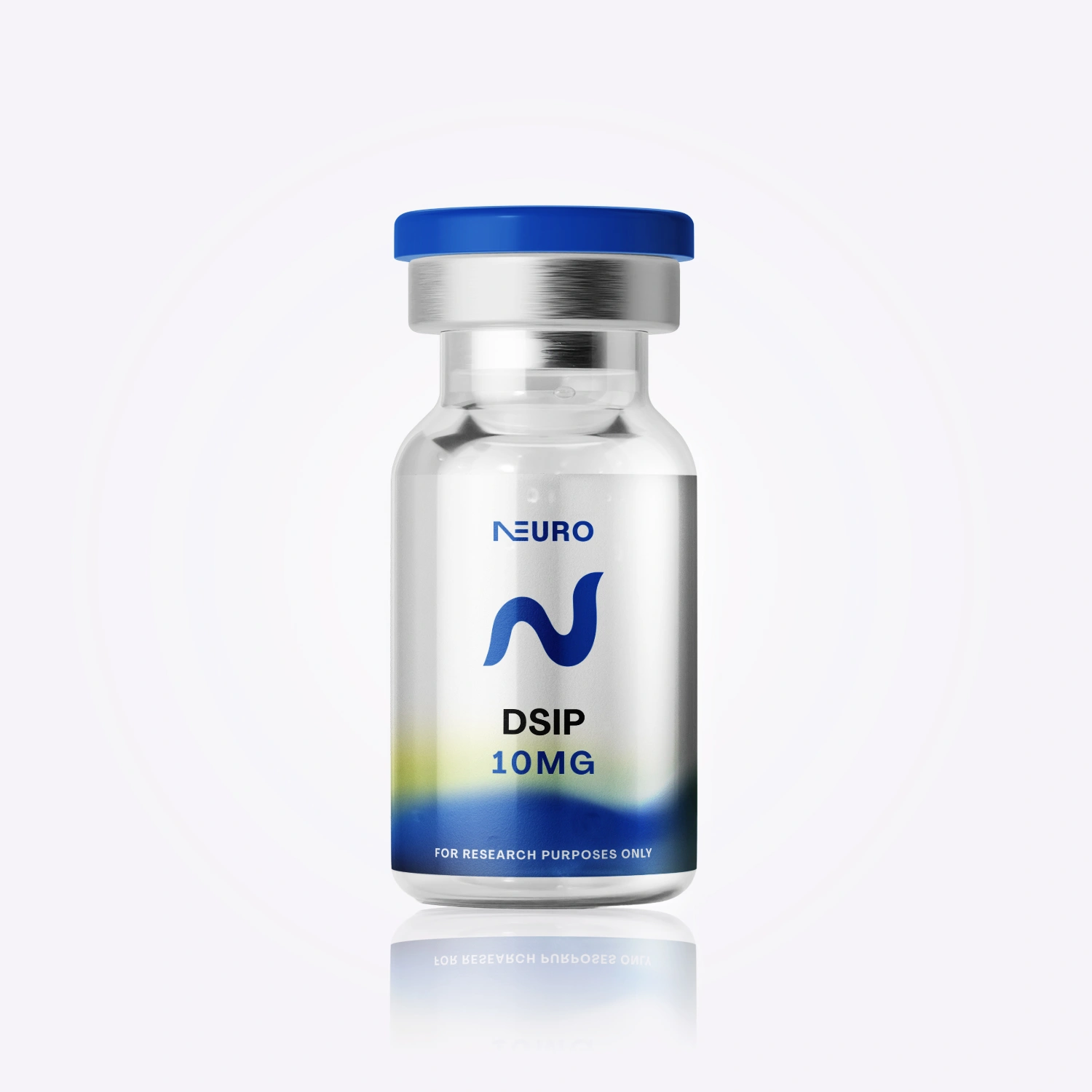
DSIP 10 mg For Sale
Neuro Peptides DSIP 10 mg is a high-purity, research-grade peptide supplied as a lyophilized powder for laboratory research applications. Delta Sleep-Inducing Peptide (DSIP) is an endogenous neuropeptide originally identified during research into sleep regulation and neuroendocrine signaling.
Since its discovery, DSIP has attracted scientific interest because of its potential involvement in several physiological and biochemical processes, including sleep-related signaling, circadian regulation, neuroendocrine activity, stress-response pathways, and cellular communication. Researchers continue to investigate DSIP to better understand how neuropeptides may influence signaling mechanisms within the nervous and endocrine systems.
DSIP 10 mg is commonly studied in laboratory settings involving neuropeptide signaling, circadian rhythms, stress-response mechanisms, neuroendocrine regulation, and peptide-mediated cellular communication. Neuro Peptides supplies DSIP 10 mg as a highly purified lyophilized research material designed to support consistency, stability, and reproducibility across controlled laboratory studies.
This product is intended strictly for research purposes and is not for human consumption or therapeutic use.
DSIP Specifications
| Specification |
Details |
| Product Name |
DSIP 10 mg |
| Full Name |
Delta Sleep-Inducing Peptide (DSIP) |
| Peptide Sequence |
Trp-Ala-Gly-Gly-Asp-Ala-Ser-Gly-Glu |
| CAS Number |
62568-57-4 |
| PubChem CID |
68816 |
| Molecular Formula |
C₃₅H₄₈N₁₀O₁₅ |
| Molecular Weight |
848.8 g/mol |
| Product Form |
Lyophilized powder |
| Appearance |
White to off-white powder |
| Product Type |
Research-grade peptide |
| Quantity |
10 mg |
| Intended Use |
Laboratory research only |
| Storage |
Store under appropriate refrigerated conditions, protected from moisture, heat, and direct light |
| Research Areas |
Neuropeptide signaling, circadian biology, neuroendocrine signaling, and stress-response research |
Mechanism of Action
The precise mechanism of action of Delta Sleep-Inducing Peptide (DSIP) has not yet been fully established. Current research suggests that DSIP may participate in several regulatory processes involving neuroendocrine signaling, sleep-related physiology, stress responses, and peptide-mediated communication within the central nervous system.
Rather than acting through one clearly defined pathway, DSIP appears to be associated with multiple physiological systems. Researchers continue to investigate its interactions with neuroendocrine pathways, neurotransmitter activity, circadian regulation, and cellular signaling mechanisms.
1. Neuroendocrine Regulation
DSIP has been studied for its potential involvement in neuroendocrine signaling and the regulation of physiological homeostasis. Research has explored possible interactions between DSIP and the hypothalamic-pituitary system, which plays an important role in coordinating hormonal activity throughout the body.
Experimental studies continue to examine how DSIP may influence communication between the hypothalamus, pituitary gland, and other endocrine tissues.
2. Sleep-Related Biological Signaling
DSIP was originally identified during investigations into sleep-related biological processes, which led to considerable scientific interest in its possible role in sleep physiology.
Researchers have examined DSIP in relation to sleep-wake regulation, circadian rhythms, and other biological processes associated with sleep. However, its exact contribution to these pathways remains under investigation, and the available evidence does not support a single, fully defined sleep-regulating mechanism.
3. Stress Response and Neurotransmitter Research
DSIP has also been investigated for its potential involvement in stress-response pathways and neurochemical signaling. Experimental research has explored whether DSIP may influence neurotransmitter activity, neuroendocrine responses to stress, and peptide-mediated communication within the nervous system.
Ongoing studies aim to clarify how DSIP interacts with these signaling networks and whether its effects are mediated directly or indirectly through other neurochemical and hormonal pathways.
Research Applications DSIP 10mg
DSIP 10 mg applications in various scientific research applications including, but not limited to, the following:
Neuroscience: Experiments with neuropeptide signaling and central nervous system physiology.
Sleep Research: Mechanisms regulating sleep and circadian biology.
Neuroendocrinology: Interaction experiments between neuropeptides and endocrine signaling.
Stress Biology: Peptide responses to physiological stress in laboratory conditions.
Peptide Research: Study of biological activities of natural neuropeptides.
Storage Instructions
Proper storage is important for maintaining the stability, integrity, and research quality of DSIP 10 mg.
Storage of Lyophilized DSIP:
Lyophilized DSIP should ideally be stored at -20°C or below for long-term stability. For shorter storage periods, unopened vials may be kept refrigerated at 2–8°C, provided they are protected from moisture, heat, and direct light. Repeated temperature fluctuations should be avoided.
Storage After Reconstitution:
After reconstitution, DSIP solutions should be stored under refrigerated laboratory conditions at 2–8°C. Proper sterile laboratory handling techniques should be used to minimize contamination and degradation.
Recommended Use Period After Reconstitution:
Reconstituted samples are generally best used within a limited period. Where no product-specific stability data are available, a 30-day refrigerated use period may be used as a conservative laboratory guideline, subject to the solvent, sterility conditions, concentration, and validated stability data for the specific preparation.
For research use only. Storage recommendations should always be verified against the product’s certificate of analysis, supplier documentation, or available stability data.
FAQs
Frequently Asked Questions About DSIP 10 mg
What is DSIP 10 mg?
DSIP 10 mg is a research-grade preparation of Delta Sleep-Inducing Peptide, an endogenous neuropeptide studied for its possible involvement in sleep-related signaling, neuroendocrine regulation, stress responses, and peptide communication within the central nervous system.
What is the amino acid sequence of DSIP?
The peptide sequence of DSIP is Trp-Ala-Gly-Gly-Asp-Ala-Ser-Gly-Glu. This sequence contains nine amino acids, making DSIP a nonapeptide.
What areas of research commonly involve DSIP?
DSIP is commonly investigated in studies related to circadian biology, neuroendocrine signaling, sleep physiology, stress-response pathways, neurotransmitter activity, and neuropeptide communication.
Is the mechanism of action of DSIP fully understood?
No. The precise mechanism of DSIP has not yet been fully established. Research suggests that it may interact with several neuroendocrine and neurochemical pathways rather than functioning through one clearly defined biological mechanism.
Why is DSIP supplied as a lyophilized powder?
Lyophilization removes water from the peptide preparation, which can help improve stability during storage and transport. Researchers can then reconstitute the material under controlled laboratory conditions when required for an experiment.
How should lyophilized DSIP be stored?
For long-term laboratory storage, lyophilized DSIP is generally kept at -20°C or below. Shorter-term refrigerated storage at 2–8°C may also be appropriate depending on supplier specifications and stability data. The material should be protected from moisture, heat, and direct light.
How should DSIP be stored after reconstitution?
Reconstituted DSIP should generally be kept refrigerated at 2–8°C under appropriate laboratory conditions. Researchers should use sterile handling procedures and follow product-specific stability information where available.
What is the molecular weight of DSIP?
DSIP has a molecular weight of approximately 848.8 g/mol and the molecular formula C₃₅H₄₈N₁₀O₁₅.
What is the CAS number for DSIP?
The CAS Registry Number for Delta Sleep-Inducing Peptide is 62568-57-4. This identifier is useful for confirming the chemical identity of the research material.
Is DSIP 10 mg intended for clinical or personal use?
No. DSIP 10 mg supplied by Neuro Peptides is intended strictly for laboratory research purposes only and is not intended for human consumption, diagnostic use, or therapeutic applications.
Why is purity important when purchasing DSIP for research?
Peptide purity can affect experimental consistency and data interpretation. Using a well-characterized research material with appropriate analytical documentation helps researchers reduce uncertainty related to contaminants or degradation products.
What documentation should researchers look for when evaluating DSIP?
Useful documentation may include a Certificate of Analysis, purity testing data, batch or lot information, analytical methods, molecular identity information, and appropriate storage specifications.
Final Thoughts
DSIP 10 mg is a very pure research peptide that has proved to be quite useful for researchers studying various aspects of sleep physiology and the functioning of the central nervous system.
This 10 mg freeze-dried powder provides all the qualities of purity, stability, and consistency needed for reliable research in a lab setting. All vials of DSIP 10 mg from Neuro Peptide are produced following strict quality control protocols and tested for reliability in experimentation.
All the Neuro Peptide products are meant for laboratory research only and are not meant for human or animal consumption.
References
- Graf, M. V., & Kastin, A. J. (1984). Delta-sleep-inducing peptide (DSIP): a review. Neuroscience & Biobehavioral Reviews, 8(1), 83-93.
- Kovalzon, V. M., & Strekalova, T. V. (2006). Delta sleep‐inducing peptide (DSIP): a still unresolved riddle. Journal of Neurochemistry, 97(2), 303-309.
- GRAF, M. V., HUNTER, C. A., & KASTIN, A. J. (1984). Presence of delta-sleep-inducing peptide-like material in human milk. The Journal of Clinical Endocrinology & Metabolism, 59(1), 127-132.
- https://pubchem.ncbi.nlm.nih.gov/compound/68816