
Buy Tirzepatide 20mg
Tirzepatide 20mg For Sale Tirzepatide 20mg is available at Neuro Peptides for laboratory and scientific research…
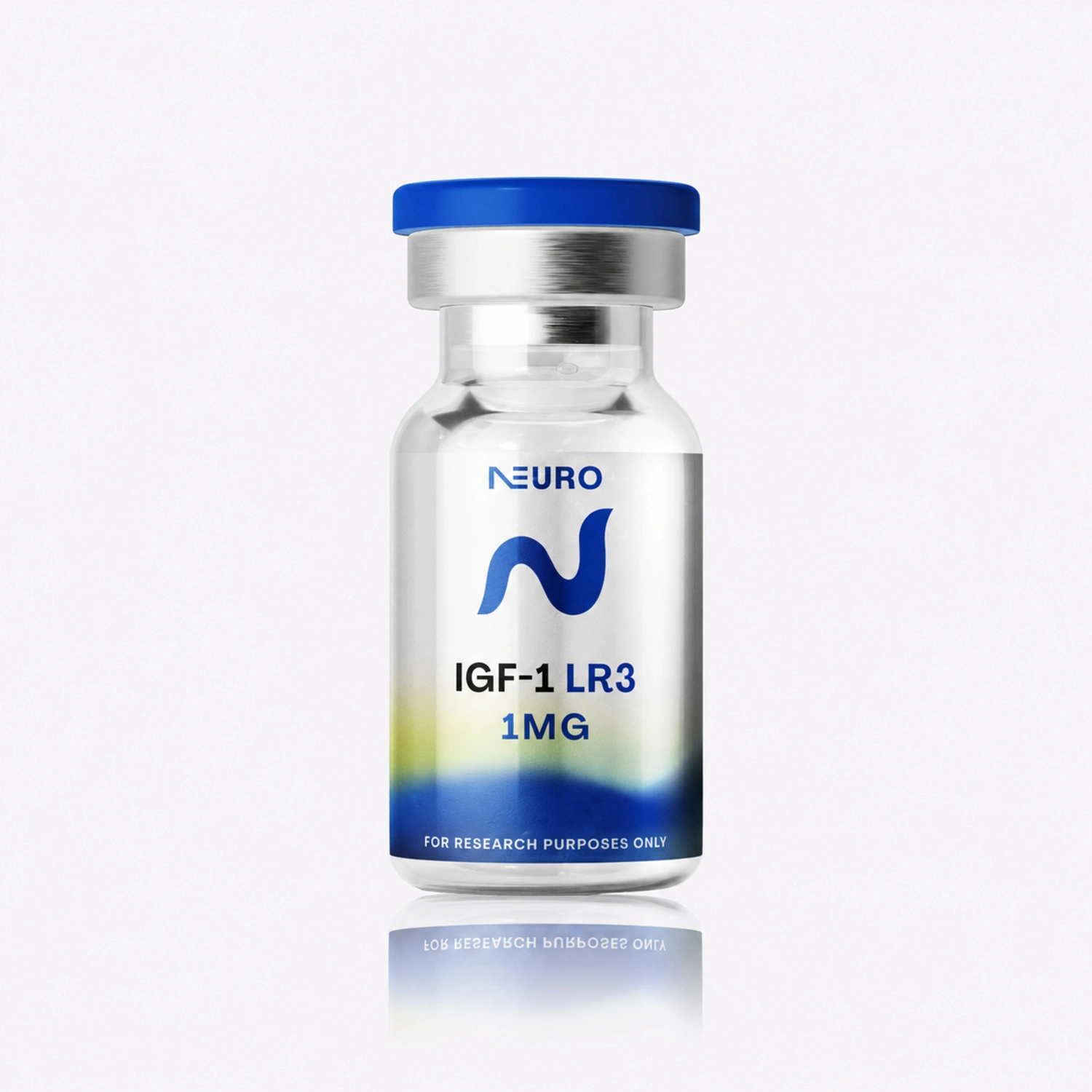
10 in stock
IGF-1 LR3 1mg is a research-grade analog of insulin-like growth factor-1 (IGF-1) supplied by Neuro Peptides as a lyophilized preparation for controlled laboratory investigation. Also known as Long R3 IGF-1, Long Arg3 IGF-1, and LR3 IGF-I, this modified growth factor is widely investigated in studies involving IGF-1 receptor signaling, IGF-binding proteins, cellular proliferation, protein synthesis, and growth-factor biology.
Unlike native human IGF-1, which consists of 70 amino acids, IGF-1 LR3 contains 83 amino acids. Its structure incorporates two important modifications: substitution of arginine for glutamic acid at position 3 of the IGF-1 sequence and the addition of a 13-amino-acid extension at the N-terminus.
These structural changes substantially reduce the interaction of Long R3 IGF-1 with insulin-like growth factor-binding proteins (IGFBPs). This characteristic has made IGF-1 LR3 particularly useful for experimental models investigating IGF-1 receptor activity and the influence of IGFBPs on growth-factor signaling.
Researchers can buy IGF-1 LR3 1mg from Neuro Peptides for laboratory research. Each product is supplied as a research-grade lyophilized material with third-party testing and batch-specific analytical documentation available.
For laboratory research only. Not intended for human or veterinary use.
| Specification | Details |
|---|---|
| Product Name | IGF-1 LR3 |
| Full Name | Long R3 Insulin-Like Growth Factor-1 |
| Synonyms | Long R3 IGF-1, Long Arg³ IGF-1, LR3 IGF-I |
| Quantity | 1 mg |
| Classification | Modified IGF-1 analog / research growth factor |
| Amino Acid Length | 83 amino acids |
| Structural Modification | Arg substitution at position 3 plus 13-amino-acid N-terminal extension |
| Molecular Weight | Approximately 9.1 kDa |
| CAS Number | Commonly cataloged as 946870-92-4 |
| Appearance | White to off-white lyophilized material |
| Purity | High-Purity |
| Testing | Third-party tested |
| COA | Batch-specific Certificate of Analysis available |
| Intended Use | Laboratory research only |
| Human Use | Not intended for human use |
| Veterinary Use | Not intended for animal or veterinary use |
IGF-1 LR3 is an engineered analog of insulin-like growth factor-1 developed to alter the way IGF-1 interacts with insulin-like growth factor-binding proteins.
Native IGF-1 circulates and functions in association with a family of IGF-binding proteins known as IGFBPs. These proteins influence the distribution and availability of IGF molecules and therefore play an important role in regulating IGF signaling.
Long R3 IGF-1 was designed with structural modifications that substantially decrease its affinity for these binding proteins.
The first modification replaces glutamic acid with arginine at position 3 of the IGF-1 portion of the molecule. The second adds a 13-amino-acid extension at the N-terminus. Together, these modifications produce an 83-amino-acid analog that has been extensively used experimentally to investigate the relationship between IGF-binding proteins and IGF-1 receptor signaling.
Because of this reduced interaction with IGFBPs, IGF-1 LR3 is particularly valuable in experimental systems where researchers want to examine IGF receptor activity while reducing the influence of IGF-binding proteins.
IGF-1 LR3 and native IGF-1 are related molecules, but they are not identical.
Natural human IGF-1 contains 70 amino acids and interacts extensively with IGF-binding proteins. IGF-1 LR3 contains 83 amino acids and incorporates structural modifications designed to reduce those interactions.
| Characteristic | Native IGF-1 | IGF-1 LR3 |
|---|---|---|
| Amino Acids | 70 | 83 |
| Position 3 | Glutamic acid | Arginine |
| N-Terminal Extension | None | 13 additional amino acids |
| IGFBP Interaction | Normal physiological affinity | Substantially reduced affinity |
| IGF-1R Activity | Present | Retained |
| Typical Research Context | Natural IGF physiology | IGFBP-independent or reduced-IGFBP experimental models |
These properties allow researchers to compare the activity of native IGF-1 with an analog that is less strongly influenced by IGF-binding proteins.
Research involving IGF-1 LR3 primarily focuses on its interaction with the insulin-like growth factor-1 receptor (IGF-1R).
IGF-1R is a receptor tyrosine kinase located on the cell membrane. Binding of an appropriate ligand to IGF-1R produces conformational changes and receptor phosphorylation, which can activate several intracellular signaling pathways.
The best-characterized pathways associated with IGF-1R include the PI3K/Akt pathway and the Ras/MAPK pathway.
IGF-1 LR3 retains biologically meaningful affinity for IGF-1R despite its substantially reduced affinity for IGF-binding proteins.
Following interaction with IGF-1R, receptor kinase activity can lead to phosphorylation of intracellular adaptor proteins, including members of the insulin receptor substrate (IRS) family and SHC proteins.
These receptor-proximal events provide researchers with an experimental model for studying downstream IGF signaling.
One major pathway downstream of IGF-1R involves phosphoinositide 3-kinase (PI3K) and Akt.
Activation of the IGF-1 receptor can recruit IRS proteins and PI3K, leading to downstream Akt signaling. Akt interacts with numerous cellular targets and is connected with processes involving metabolism, cellular survival, and regulation of protein synthesis.
The pathway can also influence mTOR signaling, making the IGF-1/IGF-1R system relevant to laboratory studies investigating translational regulation and cellular growth mechanisms.
IGF-1R activation can also initiate signaling through SHC, GRB2, SOS, Ras, RAF, MEK, and ERK.
The resulting MAPK/ERK cascade is frequently investigated in studies involving cellular proliferation, differentiation, gene expression, and growth-factor signaling.
Because Long R3 IGF-1 interacts less strongly with IGFBPs than native IGF-1, researchers have used it to examine how IGF-1R-associated signaling changes when binding-protein effects are reduced.
One of the most scientifically important characteristics of IGF-1 LR3 is its reduced affinity for IGFBPs.
IGF-binding proteins can bind native IGF molecules and modify their availability to receptors. Experimental studies have reported substantially lower IGFBP affinity for Long R3 IGF-I compared with native IGF-I.
This characteristic makes the analog useful when studying the regulatory role of IGFBPs and distinguishing receptor-mediated activity from binding-protein-mediated effects.
IGF-1 LR3 has been used across several areas of experimental biology.
Researchers use Long R3 IGF-1 to investigate IGF-1R activation and receptor-mediated intracellular signaling.
This includes research involving receptor phosphorylation, IRS proteins, SHC signaling, PI3K/Akt, and MAPK/ERK pathways.
IGF-1 LR3 can be incorporated into appropriately designed cell-culture studies examining growth-factor-dependent cellular responses.
Research areas include cellular proliferation, differentiation, survival signaling, receptor activity, and intracellular communication.
The reduced IGFBP affinity of IGF-1 LR3 makes it particularly useful for examining the regulatory effects of IGF-binding proteins.
Researchers can compare native IGF-1 with Long R3 IGF-1 to investigate how IGFBPs alter ligand availability and receptor-mediated responses.
IGF signaling intersects with the PI3K/Akt/mTOR network, which plays an important role in regulation of cellular protein synthesis.
IGF-1 LR3 has therefore been investigated in experimental models examining protein synthesis and growth-factor-associated cellular signaling.
Researchers may use IGF-1 LR3 in controlled experiments investigating expression and regulation of genes associated with IGF-1R signaling and downstream cellular responses.
The IGF system has important connections with endocrine physiology, growth-factor regulation, and cellular metabolism.
Long R3 IGF-1 provides a modified ligand that can help researchers investigate specific components of the IGF signaling system without assuming that its behavior is identical to endogenous IGF-1.
Long R3 IGF-I has also been used as a growth-factor reagent in specialized cell-culture systems.
Its reduced affinity for IGF-binding proteins can be advantageous in experimental systems where IGFBPs present in the culture environment would otherwise influence the availability of native IGF-1.
The scientific value of IGF-1 LR3 comes primarily from its engineered molecular structure.
Researchers are not simply studying another form of IGF-1. They are studying an analog specifically designed to change one of the major regulatory interactions of the native molecule: binding to IGF-binding proteins.
This makes Long R3 IGF-1 useful for questions such as:
The appropriate interpretation of these experiments depends on the specific cell type, concentration, experimental conditions, assay design, and endpoint being measured.
Neuro Peptides provides third-party tested IGF-1 LR3 1mg for laboratory research.
Independent analytical testing allows researchers to evaluate important product characteristics such as identity and purity separately from the supplier’s internal quality-control process.
Researchers should always review the documentation corresponding to the specific batch used in their experiments.
A batch-specific Certificate of Analysis (COA) is available for IGF-1 LR3 1mg from Neuro Peptides.
The COA provides researchers with analytical information associated with the relevant production batch. Depending on the testing performed, this documentation may include:
Researchers should use the COA associated with their specific lot rather than relying solely on a general product specification.
Proper storage helps preserve the integrity of IGF-1 LR3 during laboratory research.
Keep the unopened lyophilized material tightly sealed and protected from moisture, direct light, and unnecessary temperature fluctuations.
For long-term laboratory storage, follow the temperature requirements specified in Neuro Peptides’ product documentation or batch-specific stability information.
Frozen storage at approximately -20°C is commonly specified by established biochemical suppliers for Long R3 IGF-1 preparations.
Once prepared in solution, peptide and protein stability can depend on several variables, including:
Researchers should therefore follow a validated laboratory protocol or product-specific stability documentation rather than assuming that every IGF-1 LR3 solution remains stable for a fixed period.
Avoid repeated freeze-thaw cycles unless supported by the relevant experimental protocol or stability data.
IGF-1 LR3 1mg sold by Neuro Peptides is intended strictly for laboratory and scientific research.
It is not intended for human consumption, administration, diagnosis, treatment, disease prevention, veterinary use, or any other clinical application.
Neuro Peptides research materials are not marketed as pharmaceutical drugs, nutritional supplements, foods, cosmetics, or medical devices.
IGF-1 LR3 1mg is a research-grade preparation of Long R3 Insulin-Like Growth Factor-1. It is an 83-amino-acid analog of IGF-1 containing an Arg³ substitution and a 13-amino-acid N-terminal extension.
The name refers to the structural modifications that distinguish the analog from native IGF-1. The molecule contains an arginine substitution at position 3 and an additional N-terminal sequence that makes the molecule longer than native IGF-1.
Natural human IGF-1 contains 70 amino acids. IGF-1 LR3 contains 83 amino acids because of its 13-amino-acid N-terminal extension and also contains arginine instead of glutamic acid at position 3.
These modifications substantially reduce its affinity for IGF-binding proteins while retaining activity at the IGF-1 receptor.
IGF-1 LR3 is investigated in laboratory research involving IGF-1 receptor signaling, IGF-binding proteins, PI3K/Akt signaling, MAPK/ERK signaling, cellular proliferation, protein synthesis, growth-factor biology, and cell-culture systems.
Yes. IGF-1 LR3 1mg supplied by Neuro Peptides is third-party tested. Researchers can review available batch-specific analytical documentation to verify relevant product specifications.
Yes. Neuro Peptides provides a batch-specific Certificate of Analysis for IGF-1 LR3 1mg. The COA allows researchers to review the analytical results associated with the particular product batch.
IGF-1 LR3 contains 83 amino acids. Native human IGF-1 contains 70 amino acids, while Long R3 IGF-1 contains an additional 13-amino-acid N-terminal extension.
Yes, but its affinity for IGF-binding proteins is substantially reduced compared with native IGF-1. This is one of the primary molecular characteristics for which Long R3 IGF-1 is studied.
IGF-1 LR3 retains activity at the IGF-1 receptor. Experimental research has therefore used it to investigate IGF-1R-associated signaling while reducing the influence of IGF-binding proteins.
Neuro Peptides supplies IGF-1 LR3 1mg as a lyophilized research material in a laboratory vial.
Keep the lyophilized material protected from moisture, direct light, and unnecessary temperature fluctuations. Follow the storage conditions specified on the product documentation and batch-specific materials. Approximately -20°C is commonly used for long-term storage of comparable Long R3 IGF-1 research preparations.
No. IGF-1 LR3 1mg from Neuro Peptides is intended strictly for laboratory research and is not intended for human or veterinary use.
Researchers can buy IGF-1 LR3 1mg from Neuro Peptides. The product is supplied as research-grade lyophilized material with third-party testing and batch-specific COA documentation available.
IGF-1 LR3 1mg is an engineered analog of insulin-like growth factor-1 with characteristics that make it particularly useful for research involving IGF-1 receptor signaling and IGF-binding proteins.
Its 83-amino-acid structure, Arg³ substitution, and 13-amino-acid N-terminal extension distinguish Long R3 IGF-1 from native IGF-1 and substantially reduce its interaction with IGFBPs. These properties have supported its use in experimental studies involving IGF-1R signaling, PI3K/Akt and MAPK/ERK pathways, growth-factor biology, protein synthesis, and cellular research.
Neuro Peptides supplies third-party tested IGF-1 LR3 1mg with batch-specific analytical documentation available for researchers who require greater transparency regarding product identity and purity.
IGF-1 LR3 1mg is supplied strictly for laboratory research and is not intended for human or veterinary use.
Storage guidelines
Store at -20°C or -4°F Stable for up to 12 months when frozen Keep frozen until ready to reconstitute
Allow the vial to reach room temperature before opening Wait for 15-20 minutes at room temperature Handle with dry hands and equipment
Refrigerate immediately at 2-8°C, equivalent to 35.6-46.4°F temperature range Store in main refrigerator compartment, do not store in refrigerator door
Avoid repeated freeze-thaw cycles completely Keep away from direct sunlight always Use sterile alcohol swabs on vial tops Use high-quality insulated cooler during travel Use barrier like towel between ice and vials
Chemical properties

Tirzepatide 20mg For Sale Tirzepatide 20mg is available at Neuro Peptides for laboratory and scientific research…
$ 104 / vial
View Details → Buy Tirzepatide 20mg
Buy Retatrutide 20mg Retatrutide (LY3437943) is an investigational peptide developed by Eli Lilly. It has attracted…
$ 145 / vial
View Details → Buy Retatrutide 20mg
Retatrutide 10mg For Sale Retatrutide (LY3437943) is an investigational peptide originally developed by Eli Lilly. It…
$ 80 / vial
View Details → Buy Retatrutide 10mg
Thymosin Alpha-1 5mg For Sale Researchers looking to buy Thymosin Alpha-1 5mg can find research-grade, third-party…
$ 36 / vial
View Details → Buy Thymosin Alpha-1 5mg