KLOW Peptide Blend 80mg For Sale
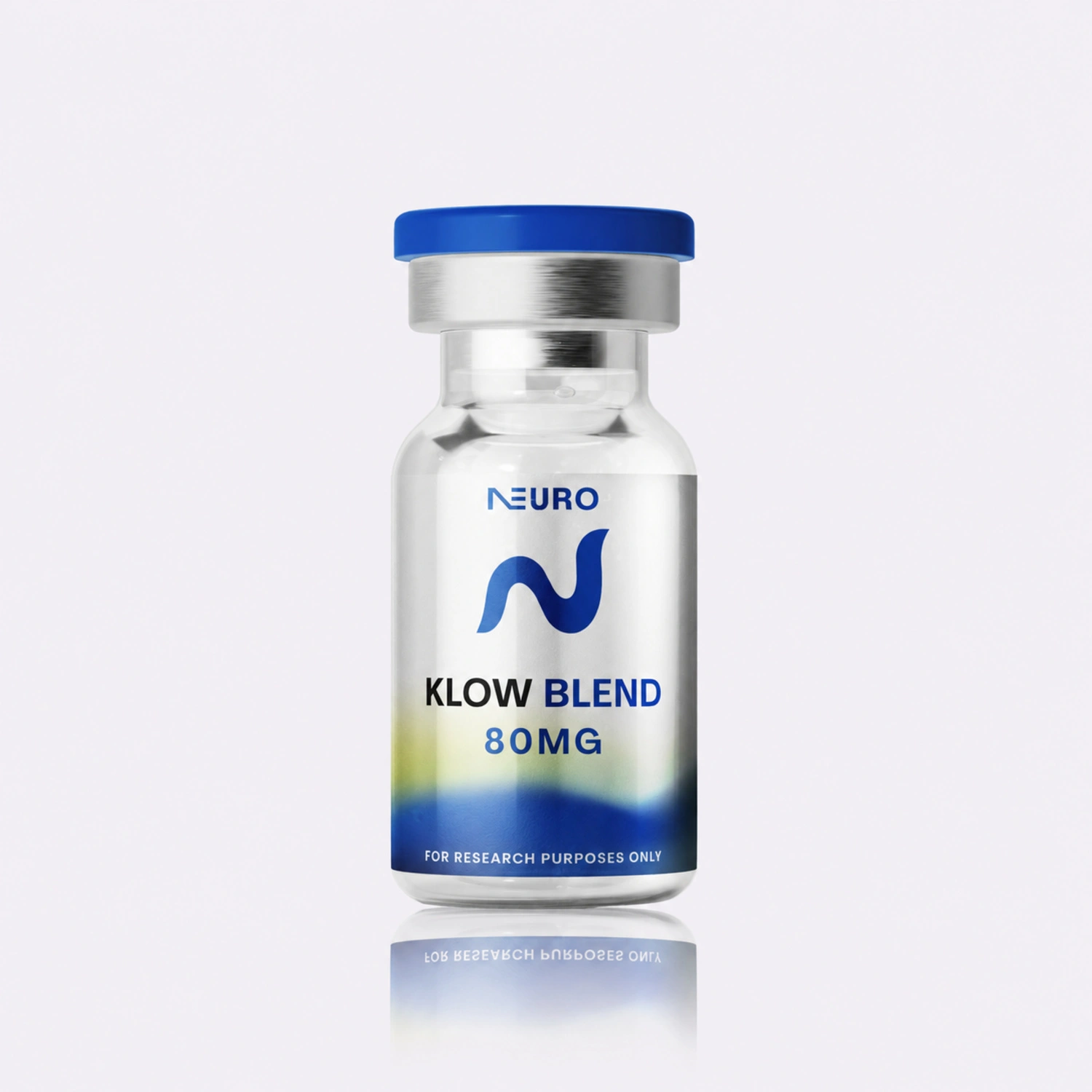
KLOW Blend 80 mg represents a research peptide formula containing four individual peptides: GHK-Cu, BPC-157, TB-500, and KPV. This formula is employed in research to investigate complicated biological processes, including tissue remodeling, inflammatory signaling, cellular repair, and intercellular signaling.
Instead of exerting its effects through one biological pathway, this formula employs peptides that exert their effects separately on various systems of the body.
The reason for scientists’ interest in such a peptide formula lies in the concept that the biological processes in the living organism are multifactorial and employ several signaling pathways, instead of employing only one mechanism. However, it must be stressed that no clinical trials have been conducted concerning this exact formula. (Pickart & Margolina, 2018; Pickart, 2008)
Why Multi-Peptide Research Formulations Are Being Studied
Recent studies in biology are now shifting to systems biology, where the interaction between signaling pathways is studied instead of individual signaling pathways. Tissue regeneration, immune response, and inflammation are controlled by networks of molecules.
Multi-peptide compounds such as KLOW Blend are used to explore the possibility that using different peptides may allow for a broader analysis of physiological interactions. Notably, this approach is experimental and does not rely on any clinical results of synergy.
Such a shift to a combination approach represents a new trend in the field of regenerative medicine and molecular biology studies. (Goldstein et al., 2012; Catania et al., 2004)
The Four Peptides in KLOW Blend 80 mg
GHK-Cu
The GHK-copper complex is a natural tripeptide found in human blood plasma that can bind to copper ions. Its effect has been extensively investigated in connection with cell regeneration, gene regulation, collagen production, and skin remodeling. It is believed that it affects regenerative and matrix-related signaling pathways. (Pickart & Margolina, 2018)
BPC-157
BPC-157 is an artificial peptide obtained from the protective sequence of a gastric protein. Preclinical investigations have shown possible involvement in angiogenesis, protective effects, and healing processes in many organs, such as muscle tissue, tendons, and the gastrointestinal tract. Most studies rely on animal and in vitro models. (Sikiric et al., 2011)
TB-500
TB-500 is related to Thymosin Beta-4, which is a protein that occurs naturally in the body and is involved in the migration of cells, the organization of the cytoskeleton, and the tissue regeneration process. This compound has been extensively studied in laboratory animals. (Goldstein et al., 2012)
KPV
The peptide KPV is a tripeptide that is derived from α-melanocyte-stimulating hormone (α-MSH). The effect of this peptide on inflammation and the maintenance of epithelial barriers has been examined in various gastrointestinal and immunological research studies. (Catania et al., 2004; Kannengiesser et al., 2008)
Scientific Rationale Behind KLOW Blend
The reason why the peptides should be combined lies in their functional complementarity:
- GHK-Cu – cellular repair and gene regulation
- BPC-157 – tissue protection and angiogenic pathways
- TB-500 – cell migration and structural restoration
- KPV – inflammation regulation and epithelial response
Altogether, they provide an opportunity to study different biological systems at once in one experiment. Nevertheless, it is important to say that there is no scientific proof of synergism in this particular combination. (Pickart & Margolina, 2018; Sikiric et al., 2020)
Potential Research Applications
Tissue Regeneration Studies
KLOW Blend ingredients have been examined independently in models for tissue regeneration and repair, especially those involving connective and soft tissues. (Goldstein et al., 2012)
Dermal and Connective Tissue Research
The GHK-Cu complex plays an important part in dermatological research with respect to collagen production and the structure of the extracellular matrix. (Pickart & Margolina, 2018)
Musculoskeletal Research Models
Laboratory research has been conducted concerning the involvement of BPC-157 and TB-500 in musculoskeletal repair. (Sikiric et al., 2011)
Inflammation and Immune Response Research
KPV has been studied in relation to inflammatory signaling and epithelial immune responses. (Catania et al., 2004)
Current Research Limitations
Although there has been increased attention towards peptide research, some drawbacks should be pointed out:
- The lack of any clinical trials conducted in relation to the combination of KLOW Blend
- The evidence comes from a separate peptide study
- The possible interactions among peptides are only hypothetical
- The effectiveness and safety of the combination in humans have not been proven yet. (Sikiric et al., 2020)
FAQs
What is KLOW Blend 80 mg used for?
It is used in laboratory research to study biological processes such as tissue repair, inflammation, and cellular signaling.
Is there clinical evidence for KLOW Blend?
No. Evidence exists only for individual peptides, not the combined formulation.
Why are these peptides combined?
They are combined to explore multiple biological pathways simultaneously in experimental research.
Is KLOW Blend approved for medical use?
No. It is strictly for research use only.
Conclusion
KLOW Blend 80 mg is a multi-peptide research formulation containing GHK-Cu, BPC-157, TB-500, and KPV with unique biological functions in regenerative and inflammatory research studies.
Although each of these peptides has been thoroughly researched in experimental models, the multi-peptide formulation is still a new concept in systems biology research. The significance of this formulation is its ability to allow researchers to study various biological pathways as opposed to a single mechanism.
The development of peptide science will enable such research tools to contribute to an increased understanding of the biology of various processes.
References
- Pickart, L., & Margolina, A. (2018). Regenerative and protective actions of the GHK-Cu peptide in the light of the new gene data. International journal of molecular sciences, 19(7), 1987.
- Pickart, L. (2008). The human tripeptide GHK and tissue remodeling. Journal of Biomaterials Science, Polymer Edition, 19(8), 969-988.
- Sikiric, P., Seiwerth, S., Rucman, R., Turkovic, B., Stancic Rokotov, D., Brcic, L., … & Sebecic, B. (2011). Stable gastric pentadecapeptide BPC 157: novel therapy in the gastrointestinal tract. Current pharmaceutical design, 17(16), 1612-1632.
- Gwyer, D., Wragg, N. M., & Wilson, S. L. (2019). Gastric pentadecapeptide body protection compound BPC 157 and its role in accelerating musculoskeletal soft tissue healing. Cell and tissue research, 377(2), 153-159.
- Sikiric, P., Hahm, K. B., Blagaic, A. B., Tvrdeic, A., Pavlov, K. H., Petrovic, A., … & Seiwerth, S. (2020). Stable gastric pentadecapeptide BPC 157, Robert’s stomach cytoprotection/adaptive cytoprotection/organoprotection, and Selye’s stress coping response: Progress, achievements, and the future. Gut and Liver, 14(2), 153.
- Goldstein, A. L., Hannappel, E., Sosne, G., & Kleinman, H. K. (2012). Thymosin β4: a multi-functional regenerative peptide. Basic properties and clinical applications. Expert opinion on biological therapy, 12(1), 37-51.
- Dubé, K. N., & Smart, N. (2018). Thymosin β4 and the vasculature: multiple roles in development, repair and protection against disease. Expert opinion on biological therapy, 18(sup1), 131-139.
- Catania, A., Gatti, S., Colombo, G., & Lipton, J. M. (2004). Targeting melanocortin receptors as a novel strategy to control inflammation. Pharmacological reviews, 56(1), 1-29.
- Kannengiesser, K., Maaser, C., Heidemann, J., Luegering, A., Ross, M., Brzoska, T., … & Kucharzik, T. (2008). Melanocortin-derived tripeptide KPV has anti-inflammatory potential in murine models of inflammatory bowel disease. Inflammatory bowel diseases, 14(3), 324-331.