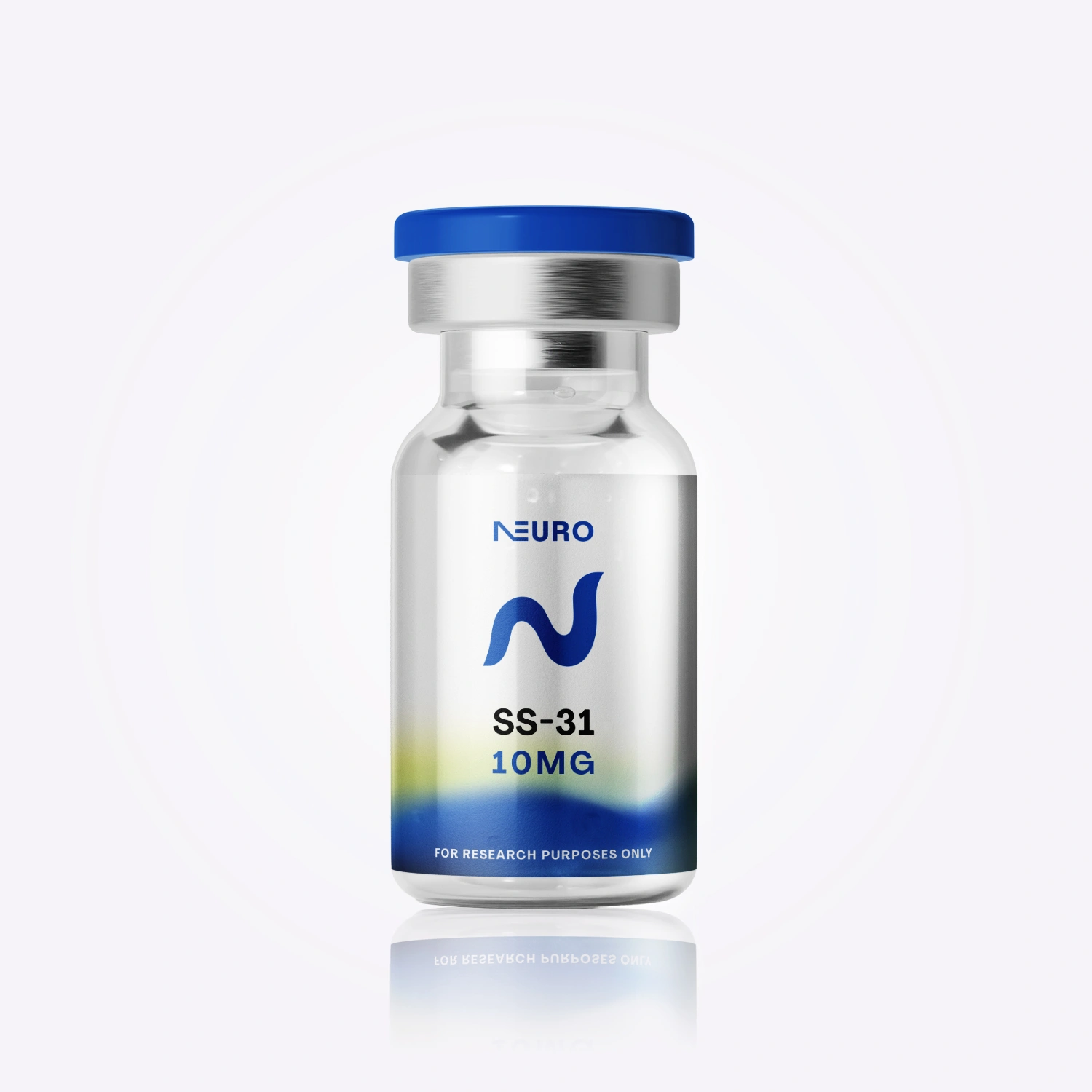
SS-31 10mg For Sale
Researchers looking to buy SS-31 10mg for laboratory studies can find research-grade SS-31 at Neuro Peptides. SS-31, also known as Elamipretide, is a mitochondria-targeting tetrapeptide widely studied for its interaction with cardiolipin, a phospholipid found in the inner mitochondrial membrane.
Unlike many peptides that primarily act through cell-surface receptors, SS-31 has been investigated for its ability to associate with mitochondrial membranes and influence processes linked to mitochondrial function, ATP production, oxidative stress, and cellular energy metabolism.
Researchers use SS-31 10mg in laboratory and preclinical studies examining mitochondrial bioenergetics, reactive oxygen species (ROS), cardiolipin-associated signaling, membrane stability, and cellular responses to mitochondrial stress.
Neuro Peptides supplies SS-31 10mg as a lyophilized research peptide for controlled scientific investigation. This product is intended strictly for laboratory research and is not for human or veterinary use.
SS-31 10mg Specifications
| Specification |
Details |
| Full Name |
Elamipretide (SS-31) |
| Alternative Name |
SS-31 |
| Peptide Sequence |
D-Arg-Dmt-Lys-Phe-NH₂ |
| Dmt Meaning |
2′,6′-Dimethyl-L-tyrosine |
| CAS Number |
736992-21-5 |
| PubChem CID |
11764719 |
| Molecular Weight |
639.8 g/mol |
| Molecular Formula |
C₃₂H₄₉N₉O₅ |
| Appearance |
White to off-white lyophilized powder |
| Purity |
≥98% by HPLC. |
SS-31: Mechanism of Action
SS-31, also known as Elamipretide, is studied for its ability to target mitochondrial membranes and interact with cardiolipin, a phospholipid found mainly in the inner mitochondrial membrane.
Researchers are interested in SS-31 because its mitochondrial localization may influence several processes involved in energy production, electron transport, membrane stability, and oxidative stress.
1. Mitochondrial Membrane Targeting
SS-31 is a small, cell-permeable tetrapeptide that can cross cellular membranes and associate with mitochondria.
Unlike many peptides that exert their effects primarily through cell-surface receptors, SS-31 has been investigated for its direct interaction with mitochondrial membrane components.
This property makes SS-31 useful in laboratory studies examining mitochondrial structure, membrane function, and cellular energy metabolism.
2. Interaction With Cardiolipin
One of the most studied features of SS-31 is its interaction with cardiolipin.
Cardiolipin is a specialized phospholipid concentrated in the inner mitochondrial membrane. It plays an important role in maintaining membrane organization and supporting proteins involved in the electron transport chain.
Research suggests that SS-31 can associate with cardiolipin and may help influence the organization and function of mitochondrial membranes.
Scientists study this interaction to better understand:
- Mitochondrial membrane stability
- Electron transport chain function
- Peptide-lipid interactions
- Mitochondrial protein organization
- Cellular responses to mitochondrial stress
3. Mitochondrial Bioenergetics and ATP Production
SS-31 is also studied for its potential effects on mitochondrial bioenergetics.
Mitochondria generate ATP through oxidative phosphorylation, a process that depends on the electron transport chain and the proton gradient across the inner mitochondrial membrane.
Researchers use SS-31 in experimental models to investigate how mitochondrial membrane organization may affect electron transport efficiency, oxygen utilization, and ATP production.
These studies are particularly useful for understanding how mitochondrial dysfunction can influence cellular energy balance.
4. Reactive Oxygen Species and Oxidative Stress
Another major area of SS-31 research involves reactive oxygen species (ROS).
ROS are natural byproducts of mitochondrial activity. However, excessive ROS production can contribute to oxidative stress and damage cellular components.
Experimental studies have examined whether SS-31 can influence ROS generation by affecting mitochondrial membrane function and electron transport.
Researchers continue to investigate how mitochondrial-targeted peptides may alter oxidative stress responses under different laboratory conditions.
5. Electron Transport Chain Function
The electron transport chain is located within the inner mitochondrial membrane and is responsible for generating the proton gradient required for ATP synthesis.
Because cardiolipin helps organize and stabilize several electron transport chain proteins, the interaction between SS-31 and cardiolipin has become an important area of mitochondrial research.
Scientists study SS-31 to better understand how changes in mitochondrial membrane structure may influence electron transport, proton gradients, and overall mitochondrial efficiency.
6. Mitochondrial Membrane Structure and Stability
SS-31 is also used in research examining the structural integrity of mitochondrial membranes.
Healthy mitochondrial membranes are important for maintaining membrane potential, electron transport, ATP synthesis, and cellular signaling.
By studying SS-31 and its interaction with cardiolipin, researchers can investigate how mitochondrial membrane organization changes during oxidative stress, metabolic stress, and other experimental conditions.
Overall, the proposed mechanism of SS-31 is closely linked to its interaction with cardiolipin and the inner mitochondrial membrane. This makes the peptide an important research tool for studying mitochondrial bioenergetics, oxidative stress, ATP production, electron transport, and membrane-associated signaling pathways.
Research Applications
SS-31 10mg is used in many research areas, which include:
Mitochondrial Biology: for studying mitochondrial structure, integrity of mitochondria, and mitochondrial function.
Cellular Bioenergetics: research Purposes on ATP Synthesis and Oxidative Phosphorylation
Oxidative Stress Research: Research Processes Associated with ROS Generation
Molecular biology: studies on peptide interactions with membranes/signaling transduction; Pharmacology of peptides: peptides for mitochondrial targeting research
Biochemistry: cardiolipin, ETC functionality.
Guidelines for Storage
Proper storage helps maintain the stability, quality, and molecular integrity of SS-31 10mg during laboratory research.
Storage of Lyophilized SS-31
SS-31 10mg in lyophilized form should be stored in a tightly sealed vial under appropriate laboratory conditions. For longer-term storage, temperatures of -20°C or below are commonly used.
The vial should be protected from:
- Direct light
- Moisture
- Repeated temperature changes
- Unnecessary exposure to air
If refrigerated storage at 2–8°C is used, researchers should follow the storage conditions and stability information supplied with the specific product batch.
Storage After Reconstitution
After laboratory reconstitution, SS-31 solutions should generally be stored under refrigerated conditions at 2–8°C, unless the experimental protocol or product documentation specifies otherwise.
Researchers should use appropriate sterile laboratory procedures during preparation, handling, and storage to reduce the risk of contamination.
Repeated freeze-thaw cycles should also be avoided where possible, as they may affect peptide stability.
Storage Duration
The usable storage period of reconstituted SS-31 can depend on factors such as the solvent, concentration, preparation method, temperature, and experimental conditions.
Researchers should therefore follow batch-specific product documentation and validated laboratory protocols rather than relying on a universal expiration period.
For research use only. SS-31 10mg is not intended for human or veterinary use.
FAQs
1. What is SS-31 10mg?
SS-31 10mg, also known as Elamipretide, is a mitochondria-targeting tetrapeptide used in laboratory research. It is widely studied for its interaction with cardiolipin and its role in mitochondrial bioenergetics, oxidative stress, and membrane function.
2. What is SS-31 10mg used for in research?
Researchers study SS-31 10mg in areas related to mitochondrial function, ATP production, oxidative phosphorylation, reactive oxygen species, cardiolipin interactions, and cellular responses to mitochondrial stress.
3. Is SS-31 the same as Elamipretide?
Yes. SS-31 and Elamipretide refer to the same peptide. SS-31 is the research designation commonly used in scientific literature, while Elamipretide is another widely recognized name.
3. Is SS-31 10mg third-party tested?
Yes. Neuro Peptides SS-31 10mg is third-party tested to help verify the quality and identity of the research material. Researchers can review the available batch documentation before use.
4. Is a Certificate of Analysis available for SS-31 10mg?
Yes. A Certificate of Analysis (COA) is available for SS-31 10mg. The COA provides batch-specific analytical information associated with the product.
5. What form does SS-31 10mg come in?
SS-31 10mg is supplied as a lyophilized powder for controlled laboratory and research applications.
6. How should SS-31 10mg be stored?
Lyophilized SS-31 should generally be stored in a tightly sealed vial under suitable laboratory conditions, with -20°C or below commonly used for longer-term storage. Researchers should follow the product documentation and validated laboratory protocols for the specific batch.
7. How long does SS-31 10mg take to ship?
Orders for SS-31 10mg are typically delivered within 3–5 business days, depending on the shipping destination and selected delivery service.
8. Where can I buy SS-31 10mg for research?
Researchers can buy SS-31 10mg from Neuro Peptides for laboratory and scientific research purposes. The product is supplied as a lyophilized research peptide with supporting quality documentation.
9. Is SS-31 10mg intended for human use?
No. Neuro Peptides SS-31 10mg is intended strictly for laboratory research purposes only. It is not for human or veterinary use.
Final Thoughts
SS-31 10mg has emerged as an important research peptide among scientists who study mitochondria, cellular bioenergetics, cardiolipin interactions, and mechanisms of oxidative stress due to its special capacity to selectively target mitochondria. It is different from a large number of traditional research peptides due to a special feature that makes it useful for studying intracellular energy metabolism and mitochondria.
The 10mg lyophilized powder possesses the necessary qualities for conducting research experiments. Each vial of SS-31 10mg offered by Neuro Peptide is made according to strict quality control standards and has been tested analytically.
All Neuro Peptide products are meant solely for scientific studies and cannot be used in humans or animals.
References
- Szeto, H. H. (2014). First‐in‐class cardiolipin‐protective compound as a therapeutic agent to restore mitochondrial bioenergetics. British journal of pharmacology, 171(8), 2029-2050.
- Birk, A. V., Chao, W. M., Liu, S., Soong, Y., & Szeto, H. H. (2015). Disruption of cytochrome c heme coordination is responsible for mitochondrial injury during ischemia. Biochimica et Biophysica Acta (BBA)-Bioenergetics, 1847(10), 1075-1084.
- Zhao, K., Luo, G., Giannelli, S., & Szeto, H. H. (2005). Mitochondria-targeted peptide prevents mitochondrial depolarization and apoptosis induced by tert-butyl hydroperoxide in neuronal cell lines. Biochemical Pharmacology, 70(12), 1796-1806.
- National Center for Biotechnology Information (NCBI). PubChem Compound Summary for Elamipretide (SS-31).
- Szeto, H. H. (2018). Stealth peptides target cellular powerhouses to fight rare and common age-related diseases. Protein and Peptide Letters, 25(12), 1108-1123.