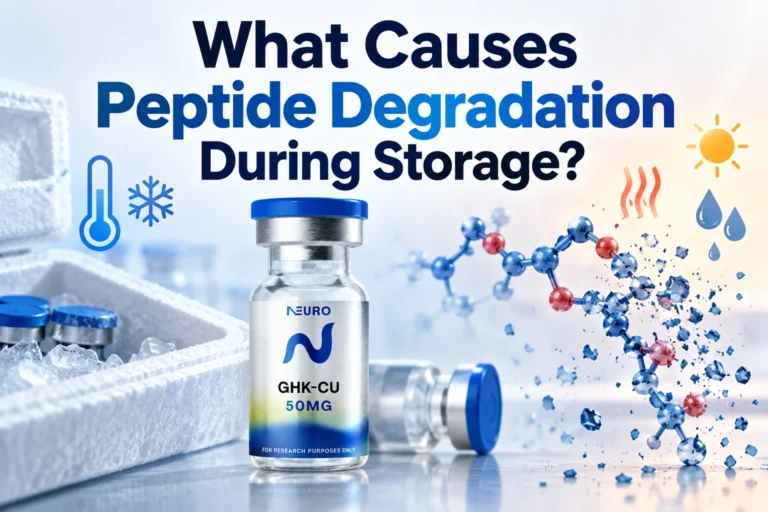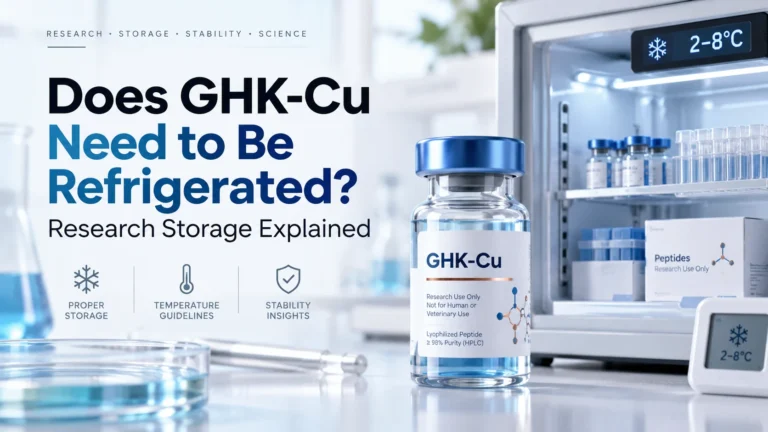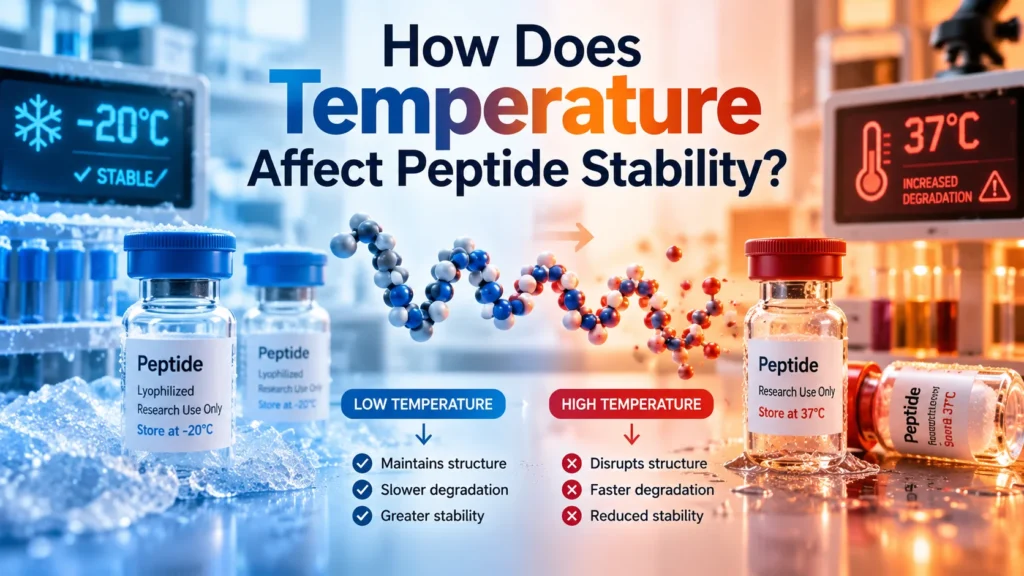
Temperature is one of the most important environmental factors affecting peptide stability. Temperature changes can influence chemical degradation, molecular conformation, aggregation, and other processes that may alter a peptide over time.
But there is no single temperature that guarantees stability for every peptide. A peptide’s sequence, formulation, physical state, pH, moisture, concentration, and surrounding environment can all change how it responds to temperature.
As stated by Nugrahadi et al., temperature affects various degradation reactions like hydrolysis, deamidation, oxidation, and thermolysis, while physical instability occurs through aggregation, precipitation, and structural rearrangements. For a closer look, see our overview of peptide degradation in storage.
Why Does Temperature Affect Peptide Stability?
Peptides can undergo chemical and physical changes during storage, although the extent and rate of these changes vary considerably between peptides and formulations. Structures of such molecules can go through chemical or physical changes when stored.
When temperature increases, many chemical processes happen faster. This can cause degradation of peptides. But the effect may vary depending on the type of degradation process.
Research on peptide stability in high-temperature aqueous solutions shows that increasing temperature can accelerate hydrolysis reactions. Although peptide bonds can be thermodynamically stable under many conditions, measurable degradation can still occur because thermodynamic stability does not necessarily imply a negligible degradation rate.
This distinction matters. A peptide may be thermodynamically stable in one sense while still undergoing chemical degradation at a measurable rate.
How Heat Can Accelerate Peptide Degradation
Higher temperatures can increase the rate of several chemical reactions.
Hydrolysis can break susceptible peptide bonds. Deamidation can alter asparagine- or glutamine-containing sequences. Oxidation can affect residues such as methionine, cysteine, histidine, tyrosine, and tryptophan.
A peer-reviewed review of peptide stability identifies temperature as an important factor in hydrolysis, deamidation, oxidation, and other degradation pathways, with the susceptibility depending partly on the peptide sequence and chemical environment.
This means that two peptides stored under identical conditions may not degrade at the same rate.
Temperature and Peptide Aggregation
Temperature can also affect physical stability.
Peptides may bind together to form aggregates. Soluble aggregates may form, or alternatively, the aggregation process can cause larger or less soluble aggregates. Aggregation can reduce the concentration of soluble monomeric peptide and alter the physical or functional properties of the preparation.
A detailed review of peptide aggregation identifies temperature, sequence, concentration, pH, excipients, surfaces, impurities, and other factors as contributors to physical stability.
Temperature can influence the balance between different molecular states. In some systems, heating promotes partial unfolding or self-association. In others, temperature changes can produce reversible structural transitions.
The response is therefore peptide-specific.
Does Cold Temperature Always Improve Peptide Stability?
Lower temperatures often slow many chemical reactions. This is one reason temperature-controlled storage is commonly used for sensitive biological molecules.
However, colder is not automatically better in every situation.
Freezing can create its own stresses. Ice formation can concentrate solutes in the remaining liquid phase and can change the local chemical environment around peptide molecules. Interfaces created during freezing and thawing may also influence physical stability.
Research on aggregation of biological molecules indicates that freezing can affect conformational stability through interactions with ice surfaces, while repeated freeze–thaw exposure can contribute to structural changes and aggregation.
For this reason, researchers consider both the storage temperature and the number of freeze–thaw cycles when evaluating stability.
Lyophilized vs. Reconstituted Peptides
The physical form of a peptide matters greatly.
A lyophilized peptide is substantially different from the same peptide after it has been dissolved. Removing water can change the environment in which degradation occurs. Once a peptide is reconstituted, water, pH, concentration, oxygen, and other formulation variables become much more relevant. This is covered further in our guide to bacteriostatic water for peptides.
Research on solid-state stability shows that peptides can undergo degradation even in the dry state, with temperature, moisture, excipients, and whether the formulation is amorphous or crystalline affecting chemical stability.
Therefore, stability information for a dry peptide should not automatically be assumed to apply to its solution form.
Temperature Works Together with Other Factors
Temperature rarely acts alone.
pH can influence hydrolysis and deamidation. Oxygen can promote oxidation. Light can contribute to photo-oxidative reactions. Concentration can affect aggregation. Container surfaces and interfaces can also influence peptide behavior.
A review of peptide developability emphasizes that chemical and physical stability are affected by factors including pH, oxidation, light, formulation conditions, aggregation, and adsorption to surfaces.
This is why meaningful stability testing normally evaluates temperature alongside other controlled variables.
How Do Researchers Test Temperature-Dependent Stability?
Peptide samples could be subjected to varying temperatures and analyzed using appropriate analytical techniques.
According to the research question, researchers might want to determine the purity of the peptide, degradation products, peptide aggregation, peptide structure, and biological activity. Batch results for our own vials are published on our third-party test results.
Accelerated-temperature studies can help identify potential degradation pathways and characterize degradation kinetics. However, elevated-temperature conditions can sometimes produce different degradation mechanisms from those observed under normal storage conditions.
Accelerated-temperature data should not automatically be treated as a direct prediction of stability at another temperature. Extrapolation requires appropriate kinetic models and evidence that the same degradation mechanism applies across the temperature range. We stock bacteriostatic water 10ml for laboratory use.
This means that one needs to understand the mechanism behind the process of degradation.
FAQs
Q1. Does heat damage peptides?
Heat can accelerate chemical and physical degradation processes in susceptible peptides. The extent depends on the peptide sequence, formulation, temperature, exposure time, and surrounding conditions.
Q2. Does refrigeration prevent peptide degradation?
Lower temperatures can slow many degradation reactions, but refrigeration does not guarantee complete stability. Some peptides can still undergo chemical or physical changes.
Q3. Can freezing damage peptides?
It can. Freezing and thawing can alter the local environment and may contribute to aggregation or other physical changes in some peptide formulations.
Q4. Are lyophilized peptides more stable than peptide solutions?
Lyophilization can improve stability for some peptides by reducing the amount of water available for certain degradation processes. However, dry-state stability still depends on temperature, moisture, formulation, and the individual peptide.
Q5. Is there one ideal storage temperature for all peptides?
No. Stability is peptide- and formulation-specific. Appropriate conditions should be based on experimentally established stability data for the particular material.
Conclusion
However, the effect of temperature on peptide stability is far more complex than the idea that “heat is bad” and “cold is good.”
High temperature may promote hydrolysis, deamidation, and oxidation. Additionally, temperature may affect aggregation and conformational changes. On the other hand, freezing adds mechanical stress to the picture.
Thus, the best way to address the issue of stability is to assess temperature in conjunction with peptide sequence, physical form, pH, moisture, concentration, formulation, light, oxygen, and freeze-thaw cycles.
For peptide studies, it is very important to comprehend the interaction of all these factors. Temperature is not just a storage parameter. It is an experimental parameter that affects the physical and chemical properties of peptides. We go into more detail in our guide to storing GHK-Cu.
References
- https://pmc.ncbi.nlm.nih.gov/articles/PMC10056213/
- https://www.sciencedirect.com/science/article/abs/pii/001670379290392V
- https://pmc.ncbi.nlm.nih.gov/articles/PMC10056213/
- https://pmc.ncbi.nlm.nih.gov/articles/PMC5665799/
- https://pmc.ncbi.nlm.nih.gov/articles/PMC8341748/
- https://pubmed.ncbi.nlm.nih.gov/10229638/
- https://pmc.ncbi.nlm.nih.gov/articles/PMC4287299/