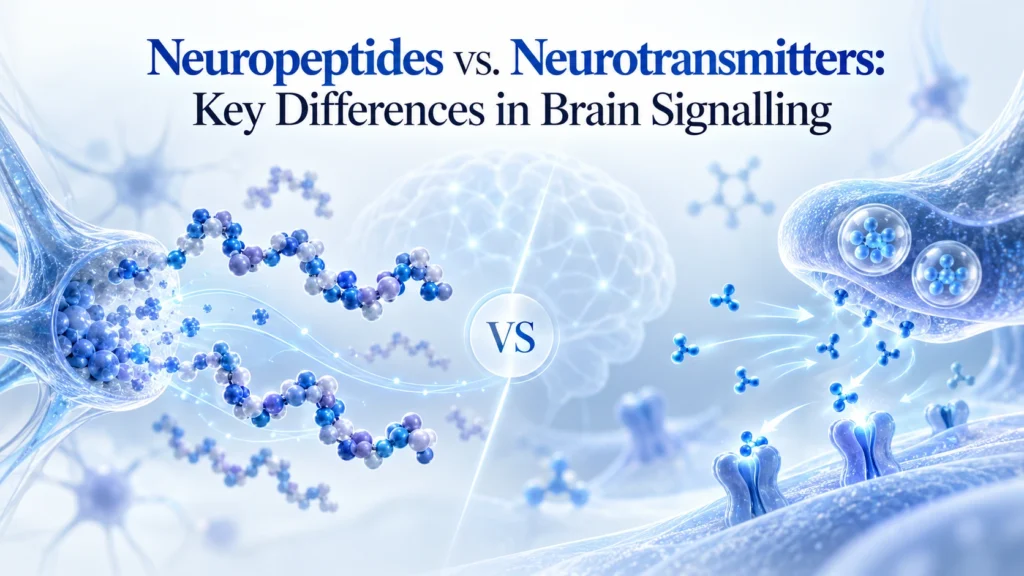
Neuropeptides and neurotransmitters are chemical messengers that help neurons communicate and regulate brain activity. However, neuropeptides are peptide-based messengers, while neurotransmitters include a broader range of signalling molecules, including neuropeptides themselves. Their differences become clearer when comparing molecular structure, synthesis, storage, release, and receptor activity.
Understanding these distinctions helps researchers interpret neural signalling mechanisms and distinguish established biological functions from simplified explanations.
What Are Neurotransmitters?
Neurotransmitters are chemical messengers released by neurons to communicate with other neurons, muscles, glands, and target cells. They bind to specific receptors and can excite, inhibit, or modify the activity of the receiving cell.
Common examples include glutamate, gamma-aminobutyric acid (GABA), acetylcholine, dopamine, and serotonin. Glutamate is a major excitatory neurotransmitter in the central nervous system, while GABA is a major inhibitory neurotransmitter in the brain.
According to Kenhub’s overview of neurotransmitters, these chemical messengers influence a wide range of physiological processes through receptor-mediated signalling.
Their effects depend on the transmitter, receptor subtype, and target cell. Some receptors produce rapid electrical responses, while others activate intracellular pathways that modify neuronal activity over longer periods.
What Are Neuropeptides?
Neuropeptides are short chains of amino acids produced by neurons and used in neural communication. They can act as neurotransmitters, neuromodulators, or signalling molecules that influence the activity of other cells. For a closer look, see our guide to neuropeptide types and functions.
Examples include substance P, neuropeptide Y (NPY), enkephalins, and beta-endorphin. These peptides participate in processes such as pain signalling, appetite regulation, and the modulation of neuronal activity.
Unlike many small-molecule neurotransmitters, neuropeptides are generally synthesized as larger precursor proteins. These precursors undergo enzymatic processing before the mature peptides are packaged into secretory vesicles.
The NCBI Bookshelf chapter on neuropeptides explains that precursor processing, vesicle storage, and release are central features of neuropeptide biology.
Neuropeptides therefore differ from many conventional neurotransmitters in how they are produced and delivered to release sites.
Neuropeptides vs. Neurotransmitters: Key Differences
Although these categories overlap, their typical molecular and cellular characteristics differ.
| Feature | Neuropeptides | Conventional small-molecule neurotransmitters |
| Molecular structure | Chains of amino acids | Small molecules, including amino acids, amines, and acetylcholine |
| Synthesis | Usually produced as precursor proteins and processed in the secretory pathway | Many are synthesized in or near nerve terminals |
| Vesicle storage | Primarily large dense-core vesicles | Commonly small synaptic vesicles |
| Release | Often requires activity patterns that recruit calcium signals sufficient to trigger dense-core vesicle release; the precise conditions depend on the neuron | Frequently triggered by rapid calcium entry near release sites |
| Receptor activity | Commonly activates G-protein-coupled receptors | Can activate ionotropic or metabotropic receptors |
| Typical effects | Often produces prolonged modulation of neuronal activity | Can produce rapid transmission or longer-lasting modulation |
These are general patterns rather than absolute rules. The Virginia Tech neuroscience textbook describes the distinct processing of peptide transmitters and their frequent coexistence with small-molecule neurotransmitters.
The key point is that neuropeptides are not separate from neurotransmission. They represent one molecular class of messengers involved in it.
How Do Their Mechanisms of Action Differ?
- Neuropeptide synthesis and release
Neuropeptide synthesis begins with precursor proteins produced in the neuronal cell body. The precursors enter the endoplasmic reticulum, pass through the Golgi apparatus, and undergo enzymatic processing. Mature peptides are packaged into large dense-core vesicles and transported to release sites.
Depending on the neuron and vesicle location, neuropeptide release may require sustained activity or stimulation that allows calcium signals to reach the release machinery.
After release, peptides bind to receptors on target cells. Many neuropeptide receptors are G-protein-coupled receptors (GPCRs), which activate intracellular signalling cascades. This is covered further in our guide to peptide certificates of analysis.
- Conventional neurotransmitter signalling
Many conventional neurotransmitters can be synthesized locally in nerve terminals and packaged into small synaptic vesicles. When an action potential reaches the terminal, calcium entry triggers vesicle fusion and transmitter release.
The released molecules cross the synaptic cleft and bind to receptors on the target cell. Glutamate acting on AMPA receptors, for example, can produce rapid excitation. GABA acting on GABA-A receptors can produce rapid inhibition.
However, not all conventional neurotransmitter signalling is fast. Dopamine and serotonin can also act through GPCRs, producing slower modulatory effects.
As DifferentBetween.com’s comparison illustrates, differences in synthesis, storage, and receptor interactions are more informative than treating signalling speed as the sole distinction.
How Do Neuropeptides and Neurotransmitters Work Together?
Neuropeptides and conventional neurotransmitters can be released from the same neuron. This process, known as co-release, allows neural communication to combine different types of signalling.
A small-molecule neurotransmitter may produce a rapid response, while a co-released peptide modifies neuronal excitability or influences subsequent responses. The resulting effect depends on neuronal activity, receptor distribution, and the local signalling environment.
Substance P provides an example. It participates in pain-related signalling and neurogenic inflammation. Neuropeptide Y, meanwhile, contributes to appetite regulation, energy balance, and the modulation of neural circuits. Selank 10mg research vial is available from our catalog.
The ResearchGate article comparing neuropeptides and neurotransmitters provides an introductory comparison of their properties. However, the distinction should not be reduced to a simple rule that peptides always act slowly, and other neurotransmitters always act quickly.
Why Do These Differences Matter in Neuroscience?
Understanding these differences helps researchers investigate how neural circuits transmit information and regulate physiological responses. Molecular structure can influence synthesis, intracellular processing, storage, and receptor interactions, while the surrounding cellular environment shapes the final response.
These distinctions also matter when interpreting experimental findings. Identifying a peptide or neurotransmitter does not, by itself, establish its complete biological role. Researchers must consider the receptor involved, experimental model, measured outcome, and limitations of the evidence.
Analytical identification of a peptide can help establish its molecular identity, but it does not independently demonstrate receptor activity or biological function. Those questions require appropriate experimental evidence.
Conclusion
The main difference between neuropeptides and conventional neurotransmitters lies in their molecular composition and typical mechanisms of synthesis, storage, and signalling. Neuropeptides are amino-acid-based messengers commonly produced from precursor proteins and stored in large dense-core vesicles. Conventional small-molecule neurotransmitters often follow different synthesis and vesicle-packaging pathways.
However, neuropeptides can themselves function as neurotransmitters. Both types of messengers contribute to coordinated neural communication, and their effects depend on receptor mechanisms and cellular context. Understanding these distinctions provides a more accurate foundation for interpreting research on brain signalling. We go into more detail in our guide to Melanotan II.
References
- https://www.kenhub.com/en/library/physiology/neurotransmitters
- https://www.ncbi.nlm.nih.gov/books/NBK28247/
- https://pressbooks.lib.vt.edu/neuroscience/chapter/neuropeptides-and-unconventional-neurotransmitters/
- https://www.differencebetween.com/difference-between-neuropeptides-and-vs-neurotransmitters/
- https://www.researchgate.net/publication/318305704_Difference_Between_Neuropeptides_and_Neurotransmitters

