
What is a Peptide Certificate of Analysis (COA)?
A Peptide Certificate of Analysis (COA) is a document that reports analytical testing performed on
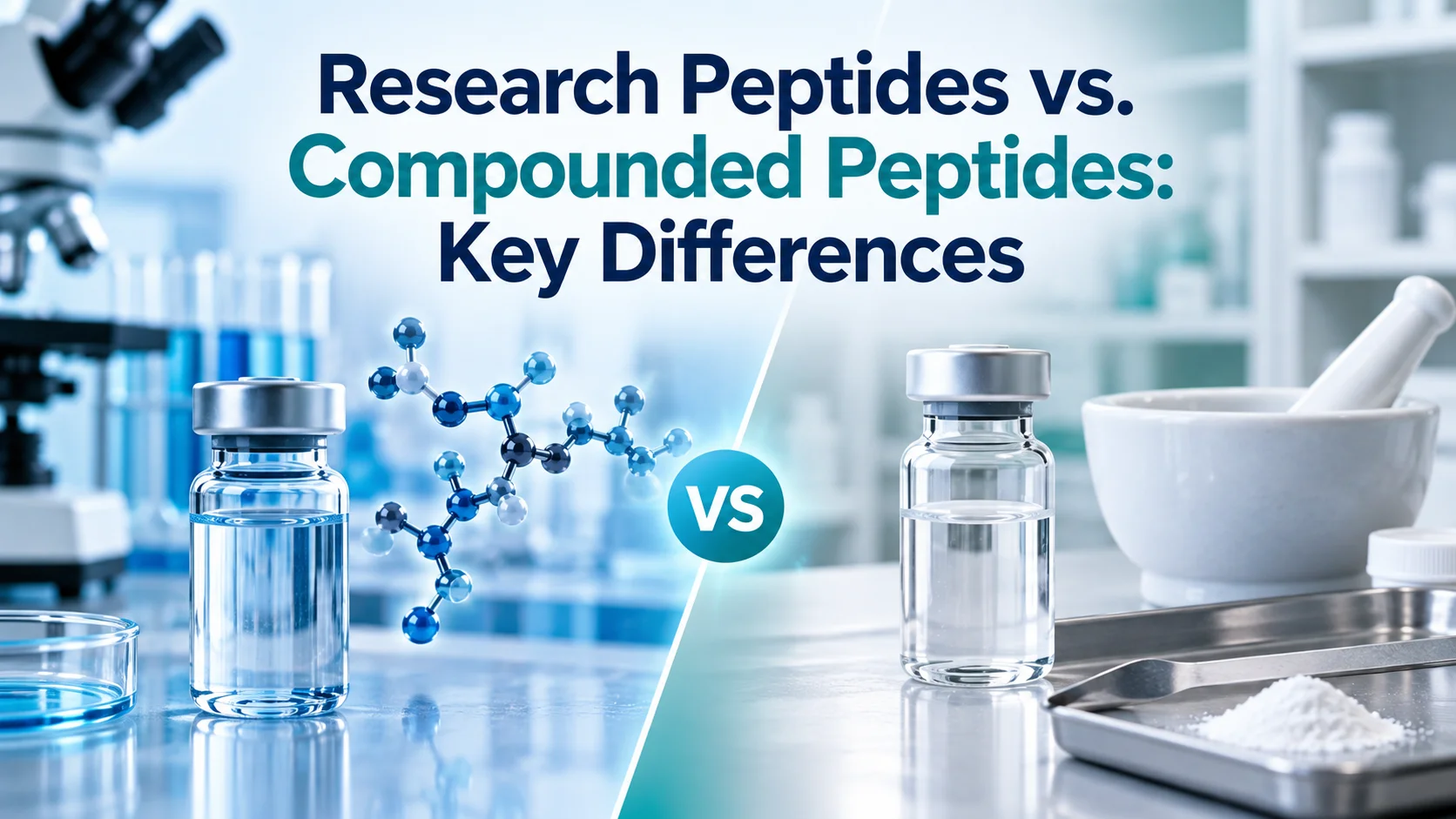
Research peptides are laboratory materials intended only for scientific research, while compounded peptides are drug preparations made by licensed pharmacies for patient-specific or clinical use under applicable U.S. compounding laws. Even when both products contain the same peptide sequence, their intended purpose, regulatory status, manufacturing standards, testing requirements, sterility expectations, labeling, and oversight can be very different.
Research peptides are supplied for laboratory investigation and are not intended for human use. Compounded peptide drugs, on the other hand, may be prepared for patients under specific legal conditions, although compounded drugs themselves are generally not FDA-approved.
According to the U.S. Food and Drug Administration (FDA), drug compounding is primarily governed by Sections 503A and 503B of the Federal Food, Drug, and Cosmetic Act. Research-use peptides fall into a different category because they are sold as laboratory materials rather than patient medications.
At Neuro Peptides, we focus exclusively on research-use materials. For researchers, understanding this distinction is important because a peptide’s advertised purity percentage or price alone does not determine whether it is suitable for research or regulated pharmaceutical use.
Research peptides are peptide materials supplied for laboratory, analytical, or in-vitro research. Depending on the project, researchers may investigate peptide structure, receptor binding, signaling pathways, molecular mechanisms, pharmacology, or other biological properties.
The phrase “research use only” describes the product’s intended research purpose; it is not an FDA designation that establishes pharmaceutical quality. This distinction is important because FDA can look beyond a disclaimer when evaluating how a specific product is marketed. In its March 2026 warning letter to Gram Peptides, FDA stated that website evidence established human-drug intended use despite “Research Use Only” and “not intended for human consumption” language.
For Neuro Peptides, this distinction is central to how research materials should be described: scientific information may explain a peptide’s properties or published research, but the product itself should remain clearly positioned for laboratory research rather than clinical treatment.
Research suppliers may provide documents such as Certificates of Analysis (CoAs), batch numbers, HPLC results, mass-spectrometry data, and other analytical information. These documents can help researchers evaluate a material, but a CoA does not make a research peptide an FDA-approved drug or demonstrate that it is suitable for administration to humans.
Compounded peptides are drug preparations compounded under applicable federal and state requirements. The two principal federal pathways discussed here are sections 503A and 503B.
According to FDA’s explanation of human drug-compounding laws, section 503A applies to compounding by licensed pharmacists in state-licensed pharmacies or by licensed physicians under specified conditions. One important condition is that the drug generally be compounded for an individual patient based on a valid prescription.
Section 503B applies to FDA-registered outsourcing facilities. The FDA’s 503A/503B comparison explains that outsourcing facilities under section 503B are subject to current Good Manufacturing Practice (cGMP) requirements, are inspected by FDA according to a risk-based schedule, and must meet additional statutory requirements.
Importantly, registration as a 503B outsourcing facility does not mean that the facility’s compounded drugs are FDA-approved. FDA explicitly states that compounded drugs are not FDA-approved and do not undergo the same premarket review for safety, effectiveness, and quality.
One of the most fundamental differences is intended use. Research peptides are supplied for scientific investigation, whereas compounded peptides are prepared as drug products within an applicable compounding framework.
This distinction becomes particularly important for peptide-related active ingredients that also have FDA-approved drug products. For example, FDA’s April 1, 2026 update states that under section 503B, outsourcing facilities generally cannot compound from bulk drug substances unless the substance appears on the 503B bulks list or the compounded drug is on FDA’s drug-shortage list under the applicable conditions. FDA stated that semaglutide and tirzepatide did not currently appear on either list at the time of that update.
FDA’s April 30, 2026 proposal sought to exclude semaglutide, tirzepatide, and liraglutide from the 503B bulks list after the agency determined it had not identified a clinical need for outsourcing facilities to compound these substances from bulk ingredients. FDA stated that it would consider public comments before making a final determination.
Manufacturing requirements are another major difference. Research-use materials can come with detailed analytical documentation, but they are not automatically manufactured under the same regulatory framework that applies to approved pharmaceutical products or section 503B outsourcing facilities.
For compounded sterile preparations, quality control includes additional concerns because contamination, incorrect strength, and other preparation problems can create direct risks to patients. USP General Chapter <797> establishes minimum standards intended to prevent harm from microbial contamination, excessive bacterial endotoxins, variability in intended strength, unintended contaminants, and inappropriate ingredient quality in compounded sterile preparations.
This is why a statement such as “99% purity” should not be interpreted as a complete pharmaceutical-quality assessment. Purity, identity, sterility, endotoxin control, strength, and manufacturing controls are separate quality considerations.
Analytical testing also needs to be interpreted correctly. HPLC can be used to assess chromatographic purity and related components, while mass spectrometry can provide information supporting molecular identity based on molecular mass. When both are available, they address different analytical questions.
For compounded sterile preparations, sterility and endotoxin controls are additional considerations. USP <797> specifically addresses microbial contamination and bacterial endotoxins because contaminated or improperly prepared sterile preparations can present significant risks when administered to patients.
FDA has also identified potential safety concerns for some peptide substances considered for compounding. For example, FDA’s current bulk-substance safety information states that compounded injectable GHK-Cu may present immunogenicity concerns associated with aggregation and peptide-related impurities, while ipamorelin acetate presents characterization and immunogenicity concerns for certain routes of administration.
A scientific publication about a peptide does not automatically establish that a particular commercial product is a medication. The specific product presentation and intended use remain important.
FDA’s 2026 warning letters demonstrate this point. In the Gram Peptides warning letter, FDA cited website claims connecting retatrutide and tirzepatide with weight-related and physiological effects when determining that the products were intended for human use despite research-use language.
For a research supplier, this distinction is fundamental. Research materials can be accompanied by scientific information about published mechanisms and experimental findings, but the products should remain clearly positioned for laboratory research rather than clinical treatment.
| Feature | Research Peptides | Compounded Peptides |
| Primary purpose | Laboratory and scientific research | Preparation of medications |
| Intended use | Research or analytical investigation | Patient-specific or other lawful compounded-drug use |
| FDA approval | Not an FDA-approved drug category | Compounded drugs are not FDA-approved |
| U.S. framework | Research-use positioning and applicable laws | Primarily sections 503A or 503B |
| Prescription | Not a patient prescription product | 503A generally involves patient-specific prescriptions |
| Manufacturing | Supplier-dependent specifications and controls | Requirements depend on 503A/503B pathway |
| Testing | May include CoA, HPLC, MS, and batch data | Quality controls depend on the compounding process and pathway |
| Sterility/endotoxin | Not established by an RUO label alone | Important for sterile compounded preparations |
| Clinical use | Not intended for clinical administration | Prepared within a clinical medication framework |
For laboratories investigating peptide chemistry, receptor activity, molecular signaling, biological mechanisms, or analytical characteristics, research-use materials are the appropriate category. Researchers should evaluate the specific product, batch documentation, analytical methods, traceability, storage requirements, and stated research purpose.
Compounded peptides serve a different role. They are prepared as drug products under applicable compounding requirements and are associated with patient care. They should therefore not be described simply as “higher-quality research peptides,” and research peptides should not be presented as substitutes for FDA-approved or lawfully compounded medications.
Products discussed in this article are presented for laboratory and scientific research purposes only. They are not intended for human or veterinary use, diagnosis, treatment, cure, mitigation, or prevention of disease.
Research peptides and compounded peptides differ in intended use, regulatory framework, manufacturing requirements, testing, sterility considerations, and clinical context. Even when the same peptide sequence is involved, the products can have very different regulatory and quality requirements.
For researchers, the most useful comparison is not simply “research grade versus compounded.” Instead, researchers should examine the specific product, intended application, analytical documentation, batch traceability, manufacturing information, and applicable regulatory framework.
About the Author
Dr. Ethan Morgan
Neuroscience & Peptide Research Specialist · Medical Author at Neuro Peptides
Dr. Ethan Morgan is a Neuroscience & Peptide Research Specialist and medical author for Neuro Peptides. He has more than 10 years of experience in scientific research, medical education, and evidence-based content.
Areas of Focus
This article has been medically and factually reviewed by Dr. Ethan Morgan to ensure accuracy, clinical relevance, and alignment with current scientific literature.
A Peptide Certificate of Analysis (COA) is a document that reports analytical testing performed on
Research peptides are laboratory materials intended only for scientific research, while compounded peptides are drug
The FDA issued warning letters to multiple companies in 2026 after reviewing their websites, inspecting
Recent FDA warning letters to peptide companies in 2026 show that products marketed as ‘research
As of September 2026, retatrutide does not have an official commercial release date. Eli Lilly
Retatrutide (LY3437943), developed by Eli Lilly and Company, is an investigational peptide currently not approved